Nov3
When rebellion crossed the St. Clair River in 1838
In June 1838, armed Patriots crossed the St. Clair River from Michigan, raiding Sombra, taking prisoners and drawing local militia and Indigenous warriors into pursuit. The conflict divided communities over British colonial rule, while some Indigenous people asserted their right to remain outside the fighting. The repercussions reached far beyond the river.
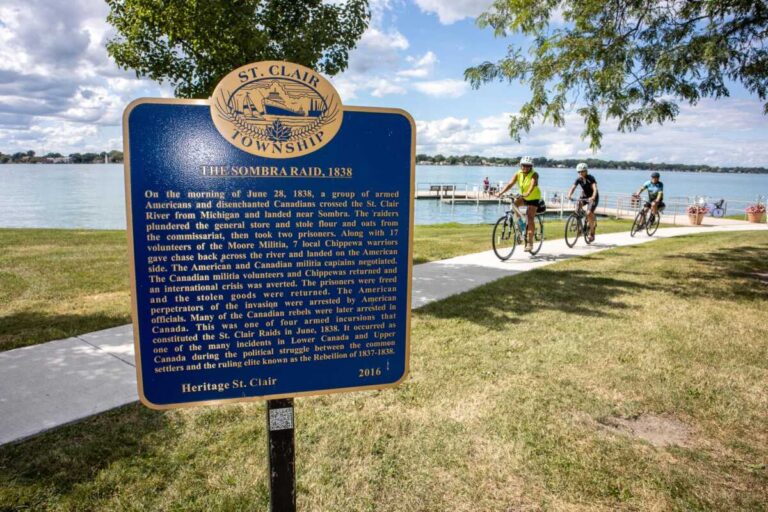
On the morning of June 28, 1838, an armed party crossed the St. Clair River from Michigan and landed near Sombra, bringing a rebellion against British colonial government directly into the communities that would become Lambton County.
The men arrived aboard a sailing vessel near the general store operated by Claude Gouin, a local merchant and justice of the peace. They removed goods from the store, then moved to a nearby military supply depot, where they seized eight barrels of flour and fifteen bushels of oats.
They also took two prisoners: Captain McDonald, who was responsible for the supplies, and Angus McDonald, a tanner from the Port Lambton area.
The raiders belonged to the Patriot movement, a loose coalition of Canadian rebels, political refugees and American supporters seeking to overthrow British authority in Upper Canada.
Their incursion was part of a series of armed crossings that unsettled communities along the St. Clair River during the summer of 1838.
More than two decades had passed since the War of 1812. Colonial settlement was expanding, and the international boundary between British North America and the United States had become a frontier where political refugees and armed insurgents could find themselves separated from their opponents by little more than the width of the river.
The immediate dispute concerned who would govern Upper Canada and how that government would be held accountable.
For years, reformers had challenged a political system in which elected representatives had limited control over an executive dominated by appointed officials and influential families.
The group commonly known as the Family Compact exercised considerable influence through government appointments, land administration and commercial relationships. Critics argued that public authority was being used to preserve the privileges of a relatively small circle.
Reformers wanted greater political accountability, although they disagreed about how to achieve it. Many sought constitutional change within the British Empire. Others increasingly believed the colonial government could only be removed by force.
In December 1837, newspaper publisher and radical reformer William Lyon Mackenzie led an uprising near Toronto. It was quickly defeated.
A separate rebellion organized by Dr. Charles Duncombe gathered supporters near Scotland, west of Brantford, but dispersed as colonial forces approached.
The defeat of the uprisings sent rebels and political refugees into the United States, where opposition to British colonial government entered a new phase.
Canadian exiles found supporters among Americans sympathetic to republican government, opposed to British authority or attracted by the possibility of political change across the border.
Some hoped to establish an independent Upper Canadian republic. Others favoured closer ties with the United States. Their objectives overlapped, but they did not share a single political program.
Armed organizations operating from American territory continued attempting to overthrow the colonial government after the original rebellion had failed.
The resulting conflict became known as the Patriot War.
For communities along the St. Clair River, Michigan settlements directly across the water became places where armed men could assemble, obtain supplies and organize incursions.
Early in 1838, Patriot forces had already attacked British positions along the Detroit River and on islands in Lake Erie. Those incursions demonstrated how an unsuccessful domestic rebellion could continue as a conflict sustained by supporters across an international border.
The possibility of further attacks kept colonial authorities and local residents on alert.
On June 22, reports of a possible incursion prompted the Moore militia to mobilize, although no invasion followed.
Four days later, an armed expedition departed from the Michigan side of the St. Clair River toward Goderich, where raiders seized goods. Another group crossed near Baby’s Point on June 27, landing at Nugent’s Inn.
According to historian John C. Carter’s research, the men raised a liberty pole and a three-coloured flag while awaiting further instructions.
Local observers initially reported that as many as 300 Patriots had landed, with another 400 expected to follow. Upper Canada’s lieutenant-governor, Sir George Arthur, subsequently estimated that fewer than 100 men were involved.
The Moore militia moved against the group and arrested six men.
The sharply differing estimates illustrate the difficulties authorities faced in establishing the size of armed groups operating along the border. Reports of anticipated reinforcements circulated alongside accounts of actual landings and arrests.
Then came the raid at Sombra.
After seizing the supplies and prisoners on June 28, the Patriots attempted to return to Michigan. Their vessel struggled against the river’s current and eventually ran aground near Reemer’s Point, south of Palmer.
Lieutenant-Colonel William Wright, commander of the Moore militia, was involved in organizing the response.
Seventeen militia volunteers and seven Chippewa warriors pursued the raiders in four log canoes, crossing toward the American shore.
Contemporary accounts describe shots being fired during the pursuit, although the precise circumstances remain unclear.
Writing from the St. Clair Mission, Indigenous interpreter and assistant missionary George Henry, also known as Maungwudaus, described Indigenous participants driving the Patriots back across the river and pursuing them onto the American side. His account survives through historical material examined by Carter.
The seven warriors’ individual identities have not been securely established. Their participation demonstrates one response to the incursion, rather than a collective position held by every Anishinaabe community in the region.
American authorities also intervened. United States officials had been attempting to prevent the Patriots from launching unauthorized attacks on British territory, and American military officer Captain John Clarke helped resolve the confrontation.
The prisoners were released and the stolen goods returned.
The confrontation had briefly created the possibility of a wider international dispute. Colonial militia and Indigenous warriors had pursued armed raiders across a boundary that both the British and American governments were determined to preserve.
Farther upriver, the alarm had reached Port Sarnia.
Richard Emeric Vidal, a former Royal Navy officer living in the settlement, recorded in his June 28 diary that the day had been occupied with fortifying the village. The magistrates had called out the militia, and news had arrived that Gouin’s store had been plundered.
His account documents the military preparations underway in Port Sarnia as the raids unfolded farther south. No corresponding attack on the village that day has been established.
The violence was also reaching settlements farther inland.
Late on June 28, according to Carter’s reconstruction, a confrontation at the home of a Mr. Lick in Dawn Township, near the Bear Creek area, resulted in the death of militia Captain William Kerry, whose surname also appears as Cary. A separate history published by Lambton County Museums dates the incident to June 27.
Historian Colin Read’s account identifies William Putnam, a former Upper Canadian militia officer who had joined the Patriots, as the man who shot Kerry. The circumstances remain disputed, however. An alternative historical account suggests that militiamen mistakenly fired on one another while attempting to arrest rebels at the house.
Putnam’s involvement illustrates the divided political loyalties of the period. He had served in the War of 1812, held public positions and established businesses in Upper Canada before becoming involved in the rebellion against its government.
Those divisions also extended into the local militia.
Under the colonial militia system, eligible men could be required to attend musters and perform military service. Appearing on a militia roll provided no guarantee that a resident supported the government’s policies.
A surviving Warwick Township militia pay list from February 1838 records three officers credited with 28 days of service and another 91 men credited with four days. Their precise assignments remain uncertain.
Among those named in the pay list was Andrew Harrower, credited with four days of service.
An account published in the Watford Guide and News in 1890 describes Harrower, a political Reformer, struggling to attend a militia muster while suffering from severe rheumatism.
According to the account, Harrower feared that failing to appear could jeopardize his land claim. He borrowed a neighbour’s horse and travelled to Warwick Village, despite being barely able to walk.
The militia pay list confirms his recorded service. The details of his illness and difficult journey come from the later account, illustrating the competing demands placed on residents who opposed the colonial government while remaining subject to its military requirements.
For Indigenous communities, participation in the conflict raised a different set of questions.
The Anishinaabek of the St. Clair region had experienced generations of political and military dealings with Britain and the United States. The territorial agreements and colonial settlement that followed the War of 1812 had changed their circumstances, but their political interests remained distinct from those of the governments surrounding them.
Upper Canadian reformers were primarily contesting how the colony would be governed. Their demands did not necessarily address Indigenous sovereignty or the continued expansion of settler control over Indigenous land.
An independent republic offered no assurance that Indigenous nations would retain greater authority over their territories.
Some Indigenous warriors cooperated with colonial militia, as the pursuit at Sombra demonstrates. Others sought to remain outside the conflict.
A statement preserved in historical research into the rebellions records the position of followers of the Anishinaabe leader Bauzhi-Geezhig-Waeshikum, also recorded as Pazhekezhikquashkum, associated with the St. Clair Mission near present-day Sarnia.
The statement appears in John Moses’s history published by the Department of National Defence. The published account does not establish its precise date, but places it within the political and military unrest of 1837–1838.
The speakers urged their people to remain outside the struggle.
They had consulted others around them and believed that fighting could expose their communities to greater hostility and loss. The dispute between the colonial government and the rebels offered them little to gain.
Their statement asserted a principle that neither side could simply set aside:
“we cannot be compelled to go & fight for any party”
The statement continued by reminding Indigenous people that they were free to make their own decisions and that no outside authority could require them to take up arms.
Its importance lay in the claim to make that decision independently. The speakers rejected the assumption that either the British authorities or their republican opponents could determine whether Indigenous people would fight.
The statement represented the position of those who issued it, rather than every Indigenous community along the St. Clair River. Their refusal and the participation of the seven warriors at Sombra were different decisions made in different circumstances.
Colonial authorities, meanwhile, continued preparing for further invasions.
In November 1838, Upper Canada’s civil secretary John Macaulay directed officials to have Indigenous warriors ready to take the field if another attack occurred.
The directive is independently dated, but the available historical record does not establish that the statement from the St. Clair Mission was written in response to it.
The two records nevertheless reveal different approaches to Indigenous military participation. Colonial officials expected they could call upon Indigenous warriors in defence of the colony, while the speakers at the mission asserted their freedom to decide whether to fight.
Those decisions formed part of the same conflict that brought colonial militia and Patriot raiders into confrontation along the St. Clair River.
For those accused of supporting the Patriots, the consequences could extend far beyond the fighting itself.
Among the men arrested in connection with the St. Clair raids was Horace Cooley, who had previously been accused of carrying messages between Patriot organizers in Michigan and disaffected residents of Upper Canada.
Cooley was subsequently convicted of burglary and sentenced to hang. His sentence was commuted, and in 1839 he was transported to Van Diemen’s Land, now Tasmania, where Britain operated a penal colony.
He was among the political prisoners removed thousands of kilometres from their homes following the failed uprising.
Across Upper Canada, the authorities arrested suspected rebels, conducted treason trials, carried out executions and transported prisoners overseas. The repression extended well beyond the brief armed encounters along the St. Clair River.
By the end of 1838, the Patriot movement’s military prospects had largely collapsed.
A final major attack at Windsor on December 4 was defeated. William Putnam, who had been implicated in the fatal confrontation near Dawn Township, was among those killed.
American enforcement of neutrality was also making further cross-border expeditions increasingly difficult.
The rebellions nevertheless exposed political problems the colonial government could not resolve through military victories alone.
In 1838, Britain sent John George Lambton, the Earl of Durham, to investigate the unrest in its North American colonies.
His report, submitted in 1839, recommended uniting Upper and Lower Canada and outlined reforms that would make the colonial executive accountable to elected representatives.
It also advocated the assimilation of French Canadians into an English-speaking political majority, reflecting the imperial assumptions that continued to shape Durham’s proposals.
The colonies were united in 1841, and responsible government was achieved in 1848 through a longer process of political organizing, negotiation and institutional change.
The connection to this region became permanent in 1849, when the area was given the name Lambton in honour of the man sent to investigate the rebellions.
The county’s name commemorates a British imperial reformer whose investigation helped reshape colonial government, rather than the local residents, Indigenous warriors or rebels whose experiences formed part of the conflict.
For communities along the St. Clair River, the conflict had brought raids, prisoners, military mobilization and political repression directly into local life. Indigenous people had also faced competing demands to participate, while some asserted their right to remain outside the fighting.
The river remained a border across which armed groups could organize and launch incursions. Its vulnerability would again become a concern nearly three decades later.
In 1866, the Fenian threat prompted renewed military preparations and the establishment of the 27th Lambton Battalion of Infantry.
The political circumstances were different, but the communities that battalion was organized to defend had already experienced the realities of an armed international frontier.
About this reporting
This article is part of The Sarnia Journal’s 11 Days of Remembrance series, examining military conflicts through the histories of people who lived in the region now known as Sarnia-Lambton.
The account of the St. Clair River raids draws principally on historian John C. Carter’s Remembering the Sombra Raid, published in the August 2016 edition of The Beacon by St. Clair Township, and his account of the wider St. Clair incursions. His research examines contemporary newspaper reports, military correspondence and eyewitness accounts, including accounts by George Henry and Richard Emeric Vidal.
Local militia service and Andrew Harrower’s experience draw on the Warwick Township militia pay records and historical recollections, including the February 1838 pay list and a retrospective account published in the Watford Guide and News on February 14, 1890.
The account of William Putnam and Captain William Kerry draws on Colin Read’s Dictionary of Canadian Biography entry and Dennis Carter-Edwards’s 2022 review in Ontario History, which discusses conflicting explanations of Kerry’s death. Carter dates the Dawn Township incident to June 28, while historical research published by Lambton County Museums gives June 27.
The Indigenous perspective draws on John Moses’s A Sketch Account of Aboriginal Peoples in the Canadian Military, published by the Department of National Defence in 2004. The statement attributed to followers of Bauzhi-Geezhig-Waeshikum at the St. Clair Mission is reproduced from that historical study. Its original manuscript has not been independently examined, and the published version does not establish its exact date or any direct connection to John Macaulay’s November 1838 instructions.
The political aftermath and county naming are supported by the Canadian Museum of History’s account of responsible government and Lambton Heritage Museum’s account of the county’s history. The formation of the 27th Lambton Battalion is documented in Lambton County Museums’ military collections.
The article distinguishes documented armed incursions from disputed accounts, militia service from political allegiance, and the decisions of individual Indigenous participants from those of their wider communities. The identities of the seven Chippewa warriors involved in the Sombra pursuit have not been independently verified.
More to read
 Rapids Family Health Team sets Nov. 2 opening for preventive care clinic
 Before Canada existed, Pontiac’s War reached the St. Clair River

 Sarnia election results 2026: Mayor, council and trustees
Events
Nov3
Nov3
Nov3
Meat Raffles @ Black Gold Brewery
Tue, Nov 3 · 6:00 pm
Black Gold Brewery 395 Fletcher St Petrolia, ON
Nov3
TV Bingo – Sarnia Seaway Kiwanis
Tue, Nov 3 · 7:00 pm
Cogeco Your TV Channel 6 – HD Channel 700 [OR] Stream with Epico App Sarnia, ON