Nov9
The Second World War transformed Sarnia-Lambton. Its consequences remain.
The Second World War transformed Sarnia-Lambton far beyond the battlefield. Canada's urgent need for synthetic rubber brought Polymer Corporation to Sarnia, accelerating the growth of Chemical Valley. Day 8 of our 11 Days of Remembrance series examines local military service, Indigenous land dispossession, the disappearance of Blue Water and an industrial legacy still shaping lives today.
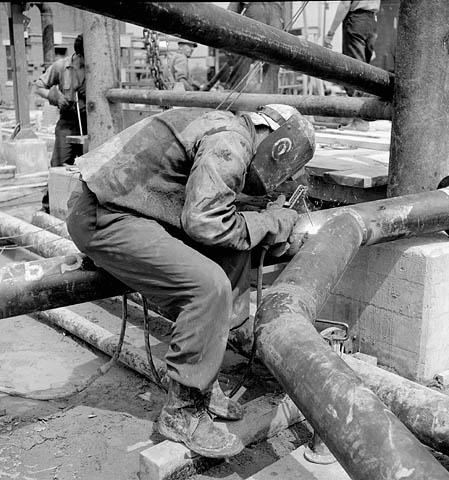
On September 29, 1943, a new industrial complex built beside the St. Clair River began operating, producing synthetic rubber for a world at war.
Polymer Corporation had been established by the Canadian government less than two years earlier, responding to a military emergency created thousands of kilometres away. Its construction brought thousands of workers to Sarnia and helped transform an established petroleum centre into one of Canada’s largest concentrations of petrochemical industry.
The factory would outlast the war, as would the consequences of its construction. Its development was connected to earlier losses of Indigenous land, while the industrial expansion that followed would eventually displace an entire working-class neighbourhood and contribute to environmental burdens that remain today.
Four years earlier, on September 10, 1939, Canada had declared war on Nazi Germany, entering a conflict that would kill tens of millions of people, destroy cities and reshape much of the world’s political order.
The war emerged from the upheavals that followed the First World War. Germany’s defeat, the Treaty of Versailles, the Great Depression and the weakening of democratic institutions created conditions exploited by Adolf Hitler and the Nazi Party. Their rise was not inevitable. It depended on organized political violence, antisemitism, support from powerful interests and the failure of institutions to resist authoritarian rule.
Nazi Germany sought territorial conquest and a racial order built on domination, persecution and the elimination of populations it regarded as enemies. Fascist Italy pursued its own imperial expansion, while Japan’s military government had already embarked on a campaign of conquest in Asia.
European governments failed to stop German aggression as Hitler remilitarized the Rhineland, annexed Austria and occupied Czechoslovakia. In August 1939, Germany and the Soviet Union signed a non-aggression pact accompanied by secret arrangements dividing much of Eastern Europe into spheres of influence.
Germany invaded Poland on September 1. Britain and France declared war two days later. On September 17, Soviet troops invaded Poland from the east, and the country was partitioned between the two powers.
Canada entered the war on September 10, following parliamentary debate and support for the government’s position. The formal declaration was issued through a proclamation by King George VI on the advice of Canada’s government.
Unlike 1914, Britain’s declaration of war did not automatically place Canada in the conflict. Canada’s constitutional independence had increased, although its military and economic connections with Britain remained substantial.
This was not simply another contest over imperial territory. Nazi occupation brought systematic persecution, forced labour, mass executions and eventually the Holocaust, in which Nazi Germany and its collaborators murdered six million Jews. Roma and Sinti, disabled people, Soviet prisoners of war, Polish civilians, political opponents and others were also subjected to persecution and mass killing.
In occupied Eastern Europe, Nazi policies included the destruction of communities, deliberate starvation and the enslavement of millions. Across Asia, Japanese military expansion produced atrocities, occupation, forced labour and enormous civilian suffering, particularly in China.
The war ultimately killed tens of millions of people, with civilians accounting for a substantial share of the dead. The Soviet Union, Poland and China suffered particularly devastating losses.
The defeat of Nazi Germany and the other Axis powers was therefore a consequential struggle against fascism, genocide and military conquest. But the countries fighting them were not free of colonialism, racial discrimination or their own violence against civilians.
The war also produced an extraordinary reversal in international alliances.
In June 1941, Nazi Germany invaded the Soviet Union, breaking the agreement signed less than two years earlier. The invasion unleashed a campaign of extraordinary destruction, transforming the Soviet Union into one of Germany’s principal enemies and a crucial Allied power.
Only two decades after Canadian troops had intervened against the Bolsheviks during the Russian Civil War, Canada and the Soviet Union were fighting a common enemy.
For Canadians, military service extended across numerous theatres. The Royal Canadian Navy expanded dramatically to escort merchant shipping through the Battle of the Atlantic, where German submarines threatened the supply routes sustaining Britain. Canadian personnel fought and were captured during Japan’s conquest of Hong Kong in December 1941. The disastrous raid on Dieppe in August 1942 brought thousands of Canadian casualties.
Canadian forces subsequently fought in Sicily and mainland Italy, landed at Juno Beach during the Normandy invasion in June 1944, and participated in the liberation of the Netherlands and the advance into Germany. Canadian aircrews served in numerous operations, including the Allied strategic-bombing campaign, which struck military and industrial targets but also devastated civilian neighbourhoods.
One local military connection reached back to the militia organizations established in Lambton during the nineteenth century.
The St. Clair Borderers, whose origins lay in the 1860s, eventually became the Lambton Regiment. In 1936, the regiment was reorganized into artillery and engineering units. Its successors included the 11th (Lambton) Field Company, Royal Canadian Engineers, which mobilized in 1939 and went overseas the following year.
Military engineers constructed defences, maintained roads and bridges, cleared mines and supported the advance of other formations. The 11th Field Company served through the campaign in northwestern Europe and into Germany.
On March 18, 1945, nine members of the company were killed when a dump of captured German anti-tank mines exploded near Kleve. Among them was Sergeant Charles Valentine Richards of Sarnia, a former laboratory assistant at Imperial Oil. The unit’s war diary recorded that the cause of the explosion was unknown.
Richards was 29. He was buried in the Netherlands, and his name is among those commemorated on the Sarnia Refinery memorial plaque honouring Imperial Oil employees who died during the war.
Even as Germany approached defeat, families in Lambton were still receiving news that their relatives would not return.
More than one million Canadians served in uniform during the war, and more than 45,000 died. The Sarnia Historical Society estimates that approximately 3,000 Sarnia men and women served. Local memorials and historical records preserve the names of those who died, although differing compilations make a single definitive countywide casualty total difficult to establish.
Aamjiwnaang residents were among those who served.
In February 1944, an honour roll was unveiled at St. Clair United Church on the Sarnia Reserve. It contained 25 names, including men and women serving with Canadian and American forces. Among those listed was Genevieve Rogers.
Another name was Harley James Williams, who enlisted on March 24, 1944, and served with the Essex Scottish Regiment. He was killed on March 8, 1945, during the campaign in the Rhineland. He was 19 years old.
Williams is commemorated on Aamjiwnaang’s cenotaph and buried at Groesbeek Canadian War Cemetery in the Netherlands.
The community’s wartime service took place under a Canadian political system that continued to deny most status First Nations people living on reserves the right to vote in federal elections. Military service provided an exception to voting restrictions, but unconditional federal voting rights would not be extended to all status First Nations people until 1960. Indigenous veterans also faced discriminatory treatment in the administration of postwar benefits.
At home, the conflict increasingly shaped daily life. Sarnia-Lambton residents bought Victory Bonds, donated blood, collected scrap materials, supported the Red Cross and adjusted to rationing and shortages. Women maintained households, undertook voluntary work, served in uniform and entered employment previously dominated by men.
In February 1945, a local campaign for the Canadian Aid to Russia Fund collected more than 1,000 pounds of clothing for the Soviet people, a tangible expression of an alliance that would have seemed extraordinary during Canada’s intervention in Russia after the First World War.
But the region’s largest and most enduring wartime transformation began thousands of kilometres away, following Japan’s entry into the war in December 1941.
Japanese forces rapidly captured much of Southeast Asia, cutting the Allies off from major sources of natural rubber. Rubber was indispensable for military vehicles, aircraft equipment, industrial machinery and transportation. Without an alternative, the shortage threatened military production across the Allied economies.
The Canadian government responded by establishing a synthetic-rubber industry, choosing Sarnia as the site of its principal project.
Sarnia was already a petroleum centre. The oilfields of Lambton County had helped establish Canada’s early petroleum industry, and Imperial Oil’s refinery, transportation connections and industrial workforce existed long before 1939. The St. Clair River provided shipping access and cooling water, while the refinery supplied petroleum materials needed for synthetic-rubber production.
In January 1942, federal minister C.D. Howe authorized construction of the Sarnia complex. Polymer Corporation was created as a Crown corporation, supported by public investment and technical arrangements involving established petroleum and chemical companies.
The project cost approximately $50 million, making it one of Canada’s largest wartime industrial undertakings. Public ownership and financing enabled construction on a scale and timetable that ordinary private investment might not have supported.
At its peak in July 1943, construction employed approximately 5,600 workers. That September, Polymer began producing synthetic rubber, with the final construction phase completed in February 1944.
The project helped supply the Allied war effort, but its effects extended far beyond military production.
Women worked within the new industrial economy. A photograph preserved by Library and Archives Canada shows Muriel McKegney of Sarnia operating laboratory equipment at Polymer in October 1943, documenting their participation in the technical work of synthetic-rubber manufacturing.
The influx of workers also placed considerable pressure on housing, roads, schools and municipal services.
Polymer was federally owned and therefore exempt from ordinary municipal property taxation. Sarnia Township, where the plant was located, faced growing expenses without receiving the revenue that would normally accompany a major private industrial development.
In April 1943, the township adopted a $5 poll tax on male residents who did not pay municipal taxes elsewhere in Ontario, directed primarily at temporary workers. Polymer management objected, concerned that the levy would worsen an already serious labour shortage.
When negotiations over financial assistance stalled, the township increased the tax to $10. Polymer eventually agreed to provide a $5,000 grant in lieu of taxes, and the township repealed the levy.
Research by political scientist Timothy Cobban, drawing on township minutes and corporate records, found that municipal expenditures increased by approximately 25 per cent between 1941 and 1944 while revenues fell slightly.
The federal government had financed an industrial project of national importance, but local officials were left negotiating how its costs would be shared.
The housing shortage helped create Blue Water, a settlement established near Polymer to accommodate its workers.
What began with barracks and bunkhouses developed into a community of homes, businesses, churches and schools. Many residents were French Canadians who had come to Sarnia for industrial employment. By 1956, Blue Water had more than 2,300 residents.
Sarnia itself was growing rapidly, but the land on which its industrial transformation occurred had a history extending far beyond the establishment of either the city or Canada.
Aamjiwnaang’s ancestors had occupied and governed territory around the St. Clair River and southern Lake Huron for generations before European settlement. British colonial treaties progressively reduced the lands available to them, including Treaty 29 in 1827, which established the Sarnia Reserve within a much larger ancestral territory.
That reserve originally contained more than 10,000 acres. Over the nineteenth and early twentieth centuries, further transactions, contested land transfers and the expansion of Sarnia substantially reduced the area under the community’s control.
One particularly consequential transaction occurred in 1919.
According to Aamjiwnaang historian David D. Plain, the City of Sarnia sought 1,184 acres of reserve land for a proposed steel plant. Community members rejected the proposed surrender in two votes.
Plain writes that the city then threatened to invoke provisions of the Indian Act commonly known as the Oliver Act, which had expanded government powers to expropriate reserve lands near growing municipalities.
The threat, according to his account, extended beyond the proposed industrial site to the entire reserve. A third vote was held, and the surrender passed under circumstances Plain describes as duress.
Although recorded as a surrender, the two earlier rejections and threatened expropriation raise fundamental questions about the freedom of the community’s consent.
The transaction occurred more than two decades before Polymer’s construction. The land was initially sought for steel manufacturing, not synthetic rubber, and the earlier transfer should not be confused with a new wartime surrender.
The connection to later industrial development is nevertheless documented.
In his history of Lambton County’s chemical industry, R.W. Ford described Polymer’s construction on 75 hectares of land that had previously formed part of the Sarnia Indian Reserve. Other historical research connects earlier industrial land transfers with the subsequent development of Polymer and neighbouring facilities.
The exact chain of title for individual parcels requires the original land records, but the broader historical relationship is established: wartime industry expanded onto territory that had already been separated from Aamjiwnaang through colonial land policies.
The Second World War did not begin Indigenous dispossession in Sarnia-Lambton. It accelerated industrial expansion within a landscape those earlier decisions had helped create.
Polymer did not close when the fighting ended. The publicly owned corporation continued producing synthetic rubber, developed research operations and found export markets. Other petroleum and chemical companies subsequently expanded or established facilities nearby, drawing on the region’s existing infrastructure, workforce and access to raw materials.
The modern Chemical Valley was not created by a single wartime decision. But the Polymer project helped establish the industrial concentration that followed.
For Aamjiwnaang, that development brought employment opportunities alongside an increasing concentration of industrial facilities surrounding the community, with consequences for the land and water upon which community life depended.
The environmental pressures accumulated over decades, involving multiple companies, manufacturing processes and government decisions. Today’s pollution cannot simply be attributed to the original wartime Polymer plant, but the federal project helped shape the industrial landscape in which later contamination occurred.
In testimony before a Senate committee in March 2024, then-Aamjiwnaang Chief Chris Plain directly connected the wartime decision to manufacture synthetic rubber in Sarnia with the subsequent growth of chemical facilities around his community.
He described consequences extending beyond measurable pollution to community health, traditional practices and the ability to exercise Aboriginal and treaty rights.
The contrast was significant. Members of the community had served in the war, while their homeland was becoming an industrial centre whose development was shaped by decisions largely outside their control.
Elsewhere in Lambton County, the war produced an even more direct seizure of Indigenous land.
In April 1942, the federal government appropriated the Stony Point Reserve from the Chippewas of Kettle and Stony Point First Nation for use as a military training base.
Community members had opposed surrendering the land. The government proceeded under the War Measures Act, using powers justified by the wartime emergency.
Approximately 15 families were displaced, with residents moved to Kettle Point. The relocation disrupted homes, community relationships and access to lands that held longstanding cultural significance.
Camp Ipperwash was established, but the land was not promptly returned when the war ended.
Stony Point residents and their descendants spent decades demanding its return. The dispute eventually became part of the history surrounding the 1995 Ipperwash confrontation, in which Ontario Provincial Police shot and killed Dudley George.
In 2016, more than seven decades after the original appropriation, the federal government and the First Nation reached a $95-million settlement establishing a process for remediation and the safe return of the former military lands.
What had been presented as a wartime military necessity became a multigenerational struggle over land and government responsibility.
These local histories reflected contradictions within Canada’s broader war effort.
The country fought a regime responsible for racial persecution and genocide, yet its own government refused admission to Jewish refugees fleeing the Nazis. In 1939, Canada was among the countries unwilling to accept passengers aboard the MS St. Louis. After the passengers returned to Europe, 254 were eventually murdered in the Holocaust.
After Japan entered the war, Canadian authorities forcibly removed more than 22,000 people of Japanese ancestry from the West Coast. Their property was confiscated and sold, and families were dispersed or confined despite the lack of evidence that they collectively posed a security threat.
These injustices did not make Canada’s actions equivalent to Nazi Germany’s program of genocide. They demonstrated that participating in the defeat of fascism did not necessarily mean abandoning discriminatory policies at home.
As Allied forces advanced through occupied Europe, they encountered further evidence of Nazi atrocities.
In April 1945, Canadian troops liberated the Westerbork transit camp in the Netherlands, finding 876 prisoners. Approximately 100,000 Jewish people, along with hundreds of Sinti and Roma, had been deported from Westerbork to concentration and extermination camps during the Nazi occupation.
The liberation of camps across Europe exposed further evidence of the systematic murder, starvation, enslavement and persecution carried out by the Nazi regime.
By the spring of 1945, Germany’s defeat was approaching.
The German invasion of the Soviet Union had become a campaign of annihilation, in which Soviet military personnel and civilians suffered catastrophic losses. The Eastern Front accounted for an immense share of the fighting and deaths in Europe.
Germany’s defeat came through the combined campaigns of the Allied powers, with the Soviet Union bearing an enormous share of the war against Nazi forces.
In April 1945, Soviet troops encircled Berlin. Hitler died on April 30, and the German garrison surrendered to the Red Army on May 2.
Germany’s unconditional military surrender followed, taking effect on May 8 in Western Europe. The Soviet Union commemorated victory on May 9.
The Soviet Union, against which Canadian forces had intervened during the Russian Civil War scarcely a generation earlier, had played a decisive role in destroying Nazi Germany.
In Sarnia, Victory in Europe Day brought a parade, decorated streets and thousands of people celebrating. Yet the city’s observance was relatively restrained, drawing criticism from some residents.
Mayor W.C. Hipple defended the approach, pointing to families whose relatives had died or remained overseas while the war against Japan continued.
A national day of prayer and thanksgiving on May 13 brought another large local procession and memorial service at the cenotaph in Victoria Park, where families of the dead laid the first wreaths.
The war against Japan ended that summer amid further devastation. The United States dropped atomic bombs on Hiroshima and Nagasaki in August 1945, killing enormous numbers of civilians and leaving survivors with severe injuries and long-term health consequences. The Soviet Union also entered the war against Japan, invading Japanese-held territory in Northeast Asia.
Japan announced its surrender in August and formally signed the surrender documents on September 2.
In Sarnia, hundreds participated in a memorial parade on August 19, marking both the end of the war and the anniversary of the disastrous Dieppe raid three years earlier. Wreaths were laid for those who had died, and religious leaders led prayers at the cenotaph.
Victory brought relief, but it also brought the reckoning of families who had lost relatives, veterans returning with physical or psychological injuries, and communities struggling with the consequences of years of war.
For Sarnia-Lambton, the industrial transformation continued.
Polymer remained in operation, while chemical manufacturing attracted further investment and employment. Yet even the communities established to support that growth were not necessarily secure.
Blue Water, which had begun as housing for the workers who built Polymer, increasingly stood in the path of Chemical Valley’s expansion.
Despite its substantial population, the community’s roads remained gravel, and it had no sewers. Residents sought improved municipal services, while plans for additional residential development stalled amid uncertainty over the cost of infrastructure and the future requirements of nearby industry.
In 1952, a Toronto developer purchased 250 acres with plans for new housing, but the project was put on hold while Sarnia considered whether to construct the sewer system that would be required. The estimated cost was $750,000.
City officials also faced the question of whether continued residential development was compatible with the expansion of nearby refineries and chemical plants. The historical record establishes that these considerations shaped municipal deliberations, although it does not establish that services were deliberately withheld to force residents out.
Ultimately, the decision was made to relocate the community.
According to a historical account by Phil Egan, 592 families were affected. The estimated relocation cost was $5.5 million, with federal funding contributing to the process.
Some houses were physically moved to new lots elsewhere in Southwestern Ontario. Others disappeared as the industrial district expanded. Polymer purchased another 130 acres in 1964, and the final expropriations occurred in 1966.
A community created because of the wartime industrial project had been dismantled to accommodate the continued expansion of the industry it helped build.
Blue Water’s experience differed from the dispossession of Indigenous reserve lands, involving different legal circumstances and histories of ownership. But it revealed another consequence of the region’s industrial development: decisions about infrastructure, housing and industrial expansion could determine where people lived and whether their communities would remain.
The war’s international consequences were equally enduring.
European imperial powers emerged weakened, while independence movements across Asia and Africa challenged colonial rule. The United Nations was established in an effort to prevent another global catastrophe, even as many peoples continued struggling for political independence.
The United States and Soviet Union emerged as rival superpowers. Their wartime alliance gave way to the Cold War, dividing Europe and extending competing political and military interests across the world.
Only five years after Germany’s surrender, another war would begin in Korea, drawing Canadian forces into a conflict on the other side of that emerging division.
In Sarnia-Lambton, however, the legacy of the Second World War remained visible in an industrial landscape that continued changing long after the fighting ended.
One part of the original Polymer complex illustrates just how long those consequences endured.
The wartime styrene facility established in 1943 eventually passed through successive corporate ownership arrangements, including Polysar, NOVA Chemicals and INEOS Styrolution.
More than eighty years after the facility began operating, its history again intersected with Aamjiwnaang.
In April 2024, elevated benzene concentrations recorded near the community prompted emergency measures. Aamjiwnaang First Nation declared a local state of emergency on April 25 after monitoring equipment recorded concentrations exceeding provincial short-term exposure guidance.
Ontario subsequently suspended an environmental approval condition permitting normal operations at INEOS Styrolution’s Sarnia facility. The province identified the company as the primary source of benzene affecting Aamjiwnaang at the time and imposed additional requirements to control emissions.
INEOS announced plans to permanently close the facility, citing deteriorating economic conditions and the investments required to keep operating. The company maintained that the closure decision was based on the site’s long-term economics rather than the regulatory orders alone.
On December 17, 2025, INEOS announced that decommissioning was complete and the facility had permanently closed. The company traced its history directly to Canada’s wartime synthetic-rubber project.
The closure ended one industrial operation but did not erase the history of the wider petrochemical complex or resolve the environmental concerns associated with decades of development.
For Aamjiwnaang, those concerns extend across the surrounding industrial district, beyond the history of any single company.
The 2024 emergency was not simply a continuation of emissions from Polymer’s original wartime operations. It reflected a much longer industrial history involving changing manufacturing processes, corporate ownership, environmental regulation and the concentration of facilities around the community.
But that history can be traced, in important part, to decisions made during the Second World War.
Canada built Polymer because it urgently needed synthetic rubber to sustain its war effort against Nazi Germany and the other Axis powers. The project contributed to that struggle and helped establish an industry that employed generations of workers.
It also accelerated development on lands shaped by earlier colonial dispossession, placed new demands on surrounding communities and contributed to the growth of an industrial economy whose benefits and burdens were not shared equally.
For Aamjiwnaang, that inheritance remains part of a continuing struggle over community health, the environment and relationships with the surrounding land and water. For the people of Stony Point, wartime military demands led to decades of displacement. For Blue Water’s former residents, industrial expansion eventually meant the loss of their neighbourhood.
The Second World War ended in 1945. In Sarnia-Lambton, the factories, the missing communities and the environmental consequences of the economy it accelerated remain part of the region’s history.
More than eighty years later, some of those wartime decisions are still shaping lives.
About this reporting
This article is part of The Sarnia Journal’s 11 Days of Remembrance series, examining military conflicts through the histories of people who lived in the region now known as Sarnia-Lambton.
The military account draws on Veterans Affairs Canada, the Canadian War Museum, the United States Holocaust Memorial Museum and The Sarnia War Remembrance Project, researched and written by local historian Tom Slater. Slater’s extensive volunteer research documents local military service, casualties, memorials and wartime history. His updated 2025 edition is available through Lambton County Archives. The history of the 11th Field Company and the deaths near Kleve draws on its contemporary war diary and records of Sergeant Charles Valentine Richards. Aamjiwnaang military participation is documented through surviving Second World War honour rolls and Veterans Affairs Canada’s records.
Polymer’s establishment and development are documented through Library and Archives Canada, R.W. Ford’s industrial history and Timothy Cobban’s academic research into Sarnia Township’s relationship with the Crown corporation.
Aamjiwnaang’s land history draws on the published work of historian David D. Plain, including his account of the 1919 surrender and the threat of expropriation. The discussion of later industrial consequences incorporates testimony given by then-Aamjiwnaang Chief Chris Plain to a Senate committee in March 2024. The precise chain of title for individual industrial parcels has not been independently reconstructed.
The history of Camp Ipperwash is supported by federal records of the 1942 land appropriation and 2016 settlement. Blue Water’s development and relocation are documented in Phil Egan’s historical account, originally published in The Sarnia Journal.
The 2024 benzene emergency is documented in Ontario’s Environmental Registry, while the facility’s closure and ownership history are recorded in INEOS Styrolution’s December 2025 announcement. The article distinguishes wartime industrial development from the cumulative environmental consequences of subsequent decades.
More to read
 Sarnia election results 2026: Mayor, council and trustees
 Former Salvation Army thrift store plans free merchandise giveaway Saturday
 County plans Nov. 9 opening celebration for Kathleen Avenue housing

Events
Nov9
Nov9
Scottish Country Dancing
Mon, Nov 9 · 7:00 pm
St Andrew’s Presbyterian Church 261 Christina St N Sarnia, ON
Nov9
cineSARNIA presents The President’s Cake
Mon, Nov 9 · 7:00 pm
Sarnia Public Library Theatre 124 Christina St. S Sarnia, ON
Nov9