
Nov6
The Boer War took Lambton from border defence to fighting for empire
Lambton’s militia was established to defend a border. A generation later, local volunteers were fighting for British expansion in South Africa. Day 5 of our 11 Days of Remembrance series examines the Boer War’s devastating human cost, Sarnia’s celebration of returning soldiers, and how imperial warfare reshaped Canada’s developing military identity.
When soldiers returned to Sarnia from South Africa at Christmas in 1900, they were greeted with a parade, speeches and presentations of gold watches.
Residents gathered at the Cromwell Street railway station to welcome them home. Military officers, civic officials, local organizations, the fire department and the Sarnia Band joined a procession through streets decorated with flags and streamers. The celebrations continued the following evening at the Boys Brigade Hall, where a packed audience heard speeches, music and recollections of the war.
The men had returned from a conflict unlike the ones that had previously shaped Lambton’s military history. They had travelled thousands of kilometres to fight for Britain in South Africa, where the empire was seeking to extend its political and economic control over two independent settler republics.
The 27th Lambton Battalion had been established in 1866 amid fears of armed incursions across the St. Clair River. A generation later, former members of that same military organization were volunteering for a war that had little to do with defending the Canadian border.
The change reflected Canada’s evolving relationship with the British Empire, and raised questions about military service, national identity and political independence that would remain unresolved long after the fighting ended.
The South African War, commonly called the Second Boer War, began in October 1899 after decades of competition between Britain and the descendants of Dutch-speaking European settlers known as Boers.
Britain controlled the Cape Colony and Natal, while the Boers had established two independent republics farther inland: the South African Republic, also known as the Transvaal, and the Orange Free State. The discovery of diamonds in southern Africa in 1867 and enormous gold deposits in the Transvaal in 1886 dramatically increased the region’s economic importance.
The discoveries attracted investors, miners and migrant workers, including large numbers of Black Africans whose labour supported the expanding mining industry. They also intensified Britain’s determination to establish political dominance throughout the region.
British officials demanded voting rights for foreign settlers, particularly British subjects who had migrated to the Transvaal. The Boer government resisted granting those rights, fearing that the newcomers would undermine its independence.
But the dispute was more complicated than a contest between colonial domination and national liberation. Both Boer republics were themselves settler states, established through European expansion onto African lands. Black African communities had their own political institutions, territorial interests and struggles against dispossession, none of which were represented by the competing governments on equal terms.
Britain’s military build-up and the Boer republics’ determination to preserve their independence brought the confrontation to war on October 11, 1899.
In Canada, the question of whether to participate provoked considerable disagreement.
Many English-speaking Canadians considered military assistance an obligation of membership in the empire. Newspapers and imperial organizations encouraged the government to send troops, arguing that Canada should demonstrate its loyalty to Britain.
Others questioned why Canadians should fight in a distant conflict serving British economic and territorial interests. Opposition was particularly strong in French-speaking Canada, although some English-speaking labour organizations and farmers also objected.
Prime Minister Wilfrid Laurier faced pressure from both sides. On October 13, he agreed to equip and transport approximately 1,000 volunteers to South Africa, where Britain would assume responsibility for their maintenance.
Laurier insisted that the decision did not establish a precedent requiring Canada to contribute troops to future British wars. Henri Bourassa, a Quebec nationalist and Liberal MP, disagreed. He resigned his parliamentary seat in protest, arguing that Canada should determine its military commitments according to its own interests.
For supporters of participation, however, serving overseas offered an opportunity to demonstrate Canada’s growing military capabilities. Canadian formations could distinguish themselves alongside British troops, even while remaining under imperial command.
That enthusiasm was apparent in Sarnia.
In October 1899, residents organized financial contributions for three local volunteers: Frederick Gorman, Kenneth Johnston and Daniel McMillan. Subscription lists were opened at local financial institutions, and supporters arranged gifts before the men departed for military training in London, Ontario.
They were among the first Canadians sent overseas. Other Lambton volunteers followed, including men who had previously served in the 27th Lambton Battalion, known as the St. Clair Borderers.
Local historical research identifies sixteen men connected to the county’s South African War memorial. Their reasons for joining were not necessarily identical. The opportunity for adventure, military experience, personal advancement, loyalty to Britain and the expectations of their communities could all influence enlistment. What is documented is that Sarnia publicly supported their participation.
The war soon challenged expectations of a swift British victory.
Boer forces initially defeated British troops in several engagements, using mobile formations and modern rifles against an empire with vastly greater military resources. Britain subsequently reinforced its armies and advanced into the Boer republics.
Canadian infantry fought at Paardeberg in February 1900, helping force the surrender of a large Boer force. The battle became a celebrated moment in Canadian military history, but the initial Canadian assault cost 18 lives and left another 63 men wounded.
By June, British troops had occupied Pretoria, the Transvaal capital. The war was nevertheless far from finished.
Boer fighters continued resisting through guerrilla operations, striking British positions and supply routes before retreating across the countryside. British forces responded with increasingly destructive efforts to deprive them of food, shelter and civilian support.
For Canadian troops, service meant long marches and patrols, difficult weather, inadequate supplies and the constant threat of disease.
The Canadian War Museum records 7,368 Canadians who served in South Africa, including 89 killed in action, 135 who died of disease and 252 wounded. Those categories do not account for every Canadian death attributed to the conflict. Veterans Affairs Canada commemorates approximately 280 Canadians who died as a result of the war.
Disease claimed more Canadian lives than enemy fire among the deaths documented by the War Museum. Enteric fever, or typhoid, was particularly deadly.
Among the dead was Daniel J. Crone, a Sarnia volunteer and former member of the 27th Lambton Battalion. He died of typhoid in Johannesburg on August 4, 1900.
Crone’s death brought the cost of the distant war directly into a Lambton household. He was buried in South Africa, while friends and family mourned him at home. He was the only man among those identified in Sarnia’s memorial research known to have died during overseas service.
His death also prompted criticism of the enthusiasm with which the war had been greeted.
At a memorial service at Albert Street Presbyterian Church on August 12, Rev. J. R. Hall challenged the public celebration of the conflict. According to a historical account by journalist Dan McCaffrey, Hall questioned whether Sarnians who cheered the fighting would feel the same way if they had witnessed the suffering in South Africa.
His remarks offered a different perspective within a community that had publicly supported its volunteers. Residents could mourn those who died, welcome those who survived and disagree about the war itself.
For the people of South Africa, the consequences were far more extensive.
As the guerrilla war continued, British commanders adopted scorched-earth policies intended to deprive Boer fighters of the resources necessary to continue resisting. Soldiers burned farms and homes, destroyed crops, seized livestock and displaced rural families.
Canadian troops participated directly in these operations. Military historian Chris Madsen, writing in the Canadian Military Journal, documented Canadian formations carrying out farm burnings and property destruction under British command. Some Canadian soldiers expressed distress or opposition to the methods, but the operations nevertheless formed part of their military service.
Canadian participation extended beyond conventional battles to a campaign that deliberately destroyed civilian property and livelihoods.
The British also established concentration camps, separating Boer and Black African civilians into different systems of detention.
Approximately 28,000 Boer civilians died in the camps, most of them women and children. Overcrowding, inadequate food, poor sanitation and infectious diseases contributed to the catastrophic mortality.
Black African communities suffered displacement, destruction of their homes and livelihoods, and confinement in separate camps where inadequate provisions, disease and coercive labour policies caused widespread suffering.
Research by South African historian Garth Benneyworth places recorded Black civilian deaths in the camps at approximately 24,000 and suggests the true number could be higher. Earlier published figures were substantially lower because British records of Black deaths were incomplete.
Benneyworth’s research also documents how Black civilians were compelled into agricultural and military-support labour through policies linking access to food with work.
The destruction extended across the countryside. Tens of thousands of farm buildings and homes were destroyed, livestock was killed or confiscated, and communities were displaced from lands on which they depended for survival.
Black Africans were also workers, scouts and sometimes armed participants in the conflict, defending their communities and pursuing different political strategies according to their circumstances.
Some supported Britain in the hope that a Boer defeat might improve their position. Others sought to remain outside the fighting or protect their communities from both armies. Their decisions reflected local struggles over land, authority and survival rather than any single African position on the war.
The eventual political settlement did not secure equal rights for them.
The Treaty of Vereeniging, signed on May 31, 1902, ended the war and placed the former Boer republics under British sovereignty. Britain offered reconstruction assistance and the prospect of eventual self-government, but the treaty postponed any decision on extending voting rights to Black Africans.
The war had also cost the lives of approximately 22,000 British and imperial military personnel, with disease accounting for most of those deaths. Thousands of Boer fighters had died, alongside the tens of thousands of civilians killed in the concentration camps.
Britain had won control of the Boer republics, but the majority of South Africans had not gained political equality or self-determination.
In 1910, the former British colonies and Boer republics were united in the new Union of South Africa. The resulting political system consolidated white-minority rule, although the Cape’s limited, property-qualified non-racial franchise remained an exception. Further discriminatory land and political restrictions followed, contributing to the longer history of segregation that preceded formal apartheid.
Back in Sarnia, the war had been understood very differently.
The Christmas 1900 celebrations took place while the fighting continued and before some of its most devastating consequences had occurred. Residents were welcoming home men who had survived difficult service overseas, and the town’s recognition of their return was genuine.
The celebrations also revealed how closely Canadian patriotism could be connected with British imperial loyalty.
Lambton Heritage Museum has documented an elaborate declaration presented to four returning Sarnia volunteers. The museum describes it as celebrating Canadian patriotism and Canada’s support for the British Empire, reflecting a contemporary understanding of the war as a struggle for civilization.
This interpretation was central to imperial culture at the time. Canadians could take pride in the achievements of their own military formations while continuing to identify their country’s interests with those of Britain.
The South African War contributed to changes in Canada’s military organization and training. Canadian formations gained overseas experience, and service within a larger imperial army encouraged the development of a distinct Canadian military identity.
Yet greater military confidence did not bring full independence over foreign policy.
At the 1902 Colonial Conference, Laurier resisted British proposals for closer imperial military commitments, insisting that Canadian self-government should not be compromised by permanent obligations to imperial defence.
For imperial supporters, service in South Africa demonstrated that Canada could take a greater place within Britain’s global military system. For opponents such as Bourassa, the same commitment illustrated the danger of allowing imperial interests to determine Canadian participation in war.
In Sarnia, the conflict’s place in local memory took lasting physical form.
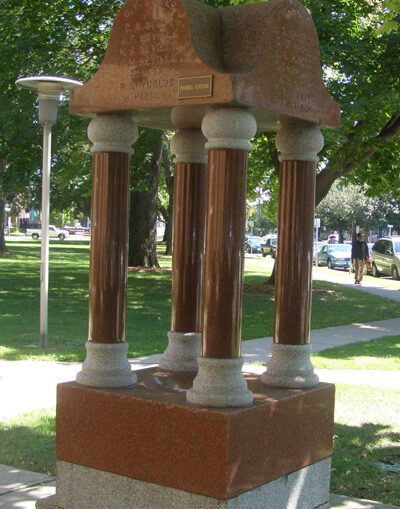
Beginning in 1902, veterans and residents raised money for a memorial to Lambton’s South African War volunteers. Schoolchildren and citizens contributed to a fountain erected in Victoria Park in 1908, bearing the names of local participants and the places where Canadian forces had served.
The fountain recognized local service, sacrifice and the community’s attachment to those who had gone overseas. It also reflected the understanding of the conflict through which that service had been publicly honoured.
The names remain part of Sarnia’s military history. So do the circumstances in which the men served, the destruction that accompanied Britain’s victory and the political questions their participation raised.
Lambton’s military tradition had expanded from guarding the St. Clair River to serving in an overseas imperial campaign. That experience helped establish Canada’s tradition of expeditionary military service, even as Canadians continued to disagree about their obligations to Britain.
When Britain declared war on Germany in August 1914, Canada again found itself at war through its imperial relationship. This time, the scale of overseas mobilization would transform the country and communities such as Sarnia-Lambton.
The question of who decided when Canadians went to war remained unresolved.
About this reporting
This article is part of The Sarnia Journal’s 11 Days of Remembrance series, examining military conflicts through the histories of people who lived in the region now known as Sarnia-Lambton.
Local enlistment, the Christmas 1900 celebrations, Daniel Crone’s death and the Boer War Memorial Fountain are documented through contemporary newspaper accounts and historical research compiled by the Sarnia Historical Society, including its individual service biographies and reproduced correspondence. Memorial information is supplemented by the City of Sarnia’s heritage records and Veterans Affairs Canada’s memorial inventory.
Rev. J. R. Hall’s criticism is attributed to a historical account by journalist Dan McCaffrey, reproduced by the Sarnia Historical Society. The original newspaper report of his remarks has not been independently examined.
Lambton Heritage Museum’s published collection description documents the declaration presented to four returning Sarnia volunteers in 1900. The description became inaccessible following the county’s website migration, and the original document was not independently inspected. The account relies on the museum’s published description rather than a direct transcription.
The broader military and political history draws on the Canadian War Museum, Library and Archives Canada, Veterans Affairs Canada and Parks Canada’s historical designation. The account of Canadian participation in farm burning draws on Chris Madsen’s study, Canadian Troops and Farm Burning in the South African War, published in the Canadian Military Journal in 2005.
The experiences of Black South Africans, including displacement, forced labour and concentration-camp deaths, draw on South African History Online and Garth Benneyworth’s research, published by South Africa’s Anglo-Boer War Museum. Civilian death figures are historical estimates, with particularly incomplete records for Black African camps.
The discussion of the political settlement draws on the Treaty of Vereeniging and historical scholarship on the establishment of the Union of South Africa.
More to read
 Indwell wins George Street appeal after years of resistance to supportive housing
 Page wins four medals at North American Indigenous Games
 Scheduled passenger flights returning to Sarnia airport Thursday
 County plans Nov. 9 opening celebration for Kathleen Avenue housing
 Lambton County Library introduces new catalogue and mobile app
Events
Nov6
Nov6
Nov7
Nov7
Breeda Miller: Turning Your Tubs of Guilt Into Your Family Story
Sat, Nov 7 · 1:00 pm
Port Huron Museums Carnegie Museum