


Oct30
A new chapter planned for historic industrial property
Troy Shantz & George Mathewson A piece of vacant industrial land in south Sarnia that played a key role in winning the Second World War will be subdivided into blocks to attract smaller industrial clients.

Troy Shantz & George Mathewson
A piece of vacant industrial land in south Sarnia that played a key role in winning the Second World War will be subdivided into blocks to attract smaller industrial clients.
City council approved a planning amendment Dec. 9 allowing Arlanxeo Canada to create the industrial subdivision on 150 acres (60 hectares) at 1265 Vidal St. S.
“It’s a good thing from a planning perspective because you’re developing brownfield sites versus greenfield sites,” said Kelly Vader, an environmental planner at B.M. Ross Associates, a company working on behalf of Arlanxeo.
“It’s definitely a good thing for Sarnia.”
Twenty-five of the site’s 62 blocks are marked for industrial development, with others for private roads, infrastructure and private wastewater treatment, according to a city planning report.
Arlanxeo has immediate plans to market the lots to individual industrial companies that want to buy or lease smaller parcels of serviced industrial land.
Zoning approvals are expected by the spring, and individual sites could start to take shape by summer, said Vader, who added talks with several interested firms are already underway.
“The advantage of having different sized parcels… is that different sizes may appeal to different companies. They can offer a lot of variety.”
The land’s industrial history dates to the Second World War, when Japan threatened the entire Allied war machine by cutting the supply of natural rubber.
Creation of the Polymer Rubber Corporation became a military priority second only to the Manhattan Project’s atomic bomb.
The Crown corporation opened in 1943, with Sarnia chosen because Imperial Oil had feedstock for the British Empire’s first synthetic rubber operation.
Today, Arlanxeo still produces high performance rubber used to make tires, automotive parts and other products. Its predecessor, Polysar, decommissioned the site between 1995 and 2002.
The new industrial subdivision is expected to make the process of setting up shop there much easier.
A portion of the land was severed in 2011 to build the BioAmber Inc. plant, now LCY Biosciences. The facility makes succinic acid, a building block used in everything from plastics to paint and food.
A second block was severed last year for Origin Materials. The U.S. biochemical company is doing site preparation for a $6-million demonstration facility.
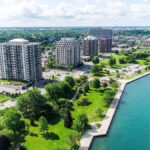
The Arlanxeo lands lie between Imperial Oil and TransAlta and bounded by Vidal Street and St. Clair River.
More to read
Events
Oct30
Sarnia Artists’ Workshop Awards/ Peg Kivi Solo Exhibition
Fri, Oct 30 · 11:00 am
The Lawrence House Centre for the Arts 127 Christina St. South Sarnia, ON
Oct30
Malice In Wonderland – BGB’s famous Halloween Parties! Yes TWO!
Fri, Oct 30 · 8:00 pm
Black Gold Brewery 395 Fletcher St. Petrolia, ON
Oct30
Oct31