Nov2
Scottish Country Dancing
Mon, Nov 2 · 7:00 pm
St Andrew’s Presbyterian Church 261 Christina St N Sarnia, ON
Long before Canada existed, Indigenous nations were fighting to defend their territory and political independence across the Great Lakes. In Day 1 of The Sarnia Journals 11 Days of Remembrance, we trace how Pontiacs War reached the St. Clair River, why Britain built Fort Sinclair, and how the conflict helped shape generations of diplomacy, resistance and territorial struggles affecting the ancestors of todays Aamjiwnaang First Nation.
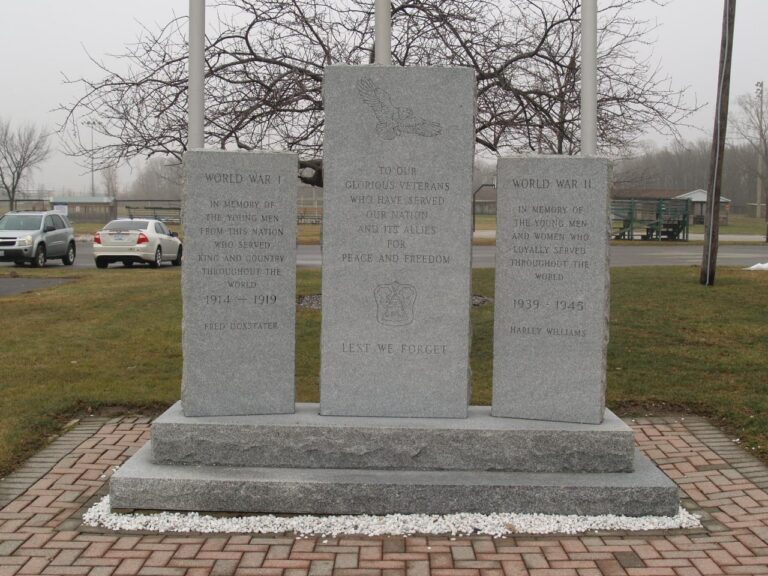
At the base of Aamjiwnaang First Nation’s cenotaph on Tashmoo Avenue, Pontiac’s War appears before the War of 1812, Korea, Vietnam and peacekeeping.
The first conflict named in that inscription began in 1763, more than a century before Canada became a country. It was fought across the Great Lakes and Ohio Country, as Indigenous nations resisted Britain’s attempts to impose authority over lands it claimed following the defeat of France.
For the Anishinaabek living along the St. Clair River, including the ancestors of today’s Aamjiwnaang First Nation, the conflict unfolded in a region that was already their homeland. Its consequences would reshape the military and diplomatic landscape around them, establishing relationships and tensions that continued long after the fighting ended.
The military history of the people who lived here did not begin when Canada did.
In the middle of the eighteenth century, the St. Clair River connected Indigenous communities rather than separating two countries. Aamjiwnaang’s own historical accounts describe a territory extending across both sides of the waterway between Lakes Huron and Erie, with villages, gathering places and family connections throughout the region.
The Ojibwe, Odawa and Potawatomi were connected through the Council of Three Fires, while individual communities maintained their own leaders, councils and diplomatic relationships. They traded, hunted, fished, cultivated crops and made decisions about their territories. The river was part of a much larger Indigenous political and economic world that existed long before Europeans began drawing boundaries across it.
French officials and traders had spent generations building relationships with Great Lakes nations through commerce, diplomacy and military alliances. These arrangements were not always peaceful or equal, but they depended on negotiation with Indigenous leaders whose cooperation could not simply be commanded.
That balance began to change when Britain defeated France in the Seven Years’ War.
British troops took control of Detroit in 1760, and the Treaty of Paris in February 1763 transferred France’s claims over much of its former North American empire to Britain. British officials viewed the territory as part of their victory. But the Indigenous nations living there had not surrendered their lands, and the defeat of one European power did not mean they had been conquered by another.
Under British commander Jeffery Amherst, relations deteriorated. Amherst reduced the diplomatic gifts that had helped sustain earlier alliances and restricted access to ammunition and other supplies.
The exchange of gifts was part of maintaining political relationships, acknowledging obligations and renewing agreements. Ammunition was essential for hunting and providing food, not just for fighting wars. Restrictions on trade and supplies threatened both livelihoods and established diplomatic arrangements.
Meanwhile, colonial settlement was pushing farther into Indigenous territories, particularly in the Ohio Country. British authorities increasingly expected compliance from nations that had never accepted British rule.
By the spring of 1763, those tensions had erupted into war.
Obwandiyag, commonly known as Pontiac, was an Odawa war chief who helped organize resistance around Detroit. He brought together warriors from several nations in an effort to drive British forces from their posts and challenge the new imperial order.
Although the conflict bears his name, Pontiac did not command every Indigenous force involved. Ojibwe, Odawa, Potawatomi, Wendat, Lenape, Shawnee and other communities pursued their own interests, sometimes cooperating militarily while retaining their own leadership.
The resistance was extensive. British posts throughout the interior came under attack, and several were captured. At Fort Detroit, Pontiac’s attempted surprise attack in May 1763 failed after the British commander received a warning, but the fort remained under siege for months. In June, Ojibwe warriors captured Fort Michilimackinac, an important post linking the upper Great Lakes to the British military network.
The fighting reached the St. Clair River almost immediately.
On May 6, 1763, a British expedition was travelling north along the river, attempting to determine whether armed sailing vessels could navigate the route between Detroit and Lake Huron. Such a passage would allow Britain to transport soldiers and supplies through the upper Great Lakes.
The party included Lieutenant Charles Robertson, who commanded British vessels on Lake Erie, Sir Robert Davers and John Rutherfurd, whose account of what followed survives.
Rutherfurd described reaching the Pine River, where French-Canadian workers warned that Indigenous warriors were preparing an attack farther upriver. Robertson continued despite the warning.
The party was subsequently attacked by Ojibwe warriors. Robertson, Davers and two other members of the expedition were killed, while Rutherfurd was captured. Davers had also been travelling with an enslaved Pawnee boy, whom the surviving account mentions but does not name.
Rutherfurd’s surviving narrative describes the attack and his subsequent captivity among Ojibwe people. Although the precise location is uncertain, the encounter demonstrated how vulnerable Britain’s military transportation route through the St. Clair River had become.
For British commanders, the river was an essential passage connecting Detroit with Lake Huron and Michilimackinac. For the Indigenous peoples who lived along it, the same waterway sustained communities and connected them to the wider Great Lakes.
The war exposed just how limited Britain’s control of that territory remained.
In October 1763, as the fighting continued, King George III issued the Royal Proclamation. It introduced rules restricting colonial settlement and private purchases of Indigenous lands, requiring land acquisitions to proceed through the Crown.
The proclamation was not simply a response to Pontiac’s War. British officials had already been considering how to administer their newly claimed territories. But the conflict demonstrated the dangers of attempting to establish colonial authority without negotiating with the Indigenous nations already living there.
The document acknowledged Indigenous possession of land while asserting the Crown’s authority to regulate how that land could be acquired. That tension would become a defining feature of the colonial relationship.
Along the St. Clair River, Britain’s response also took a more physical form.
In 1764, British officer Patrick Sinclair received orders to construct a small military fortification where the Pine River meets the St. Clair River, at what is now St. Clair, Michigan. The new Fort Sinclair was intended to protect shipping between Detroit and Michilimackinac, a route whose vulnerability had become impossible to ignore.
The fort subsequently became a trading post as well as a military installation. Sinclair also pursued his own interests in the surrounding territory, obtaining a private deed for land from local Ojibwe leaders and developing an estate known as the Pinery.
The St. Clair Historical Museum traces the fort’s establishment to Britain’s need to protect its Great Lakes transportation network following the conflict.
Today, the site lies on the Michigan side of the river. In 1764, however, there was no international border dividing the St. Clair corridor. Fort Sinclair brought a new British military presence to a region where Indigenous communities had maintained relationships across both shores for generations.
Yet the war had also shown that forts and armed vessels could not, on their own, secure Britain’s position in the Great Lakes. Diplomacy remained essential.
During the summer of 1764, Indigenous leaders from across the region gathered at Niagara to negotiate peace, renew relationships and restore trade with the British. The meetings, convened by Superintendent of Indian Affairs Sir William Johnson, involved speeches, councils, the exchange of gifts and wampum, through which the parties expressed and recorded their commitments.
The negotiations had direct connections to the St. Clair region. A surviving treaty dated July 18, 1764 records a peace and friendship agreement between Johnson and four Wendat chiefs from the Detroit region. Library and Archives Canada describes the communities they represented as living on both sides of the St. Clair River.
The wider gathering, often remembered as the Treaty of Niagara, helped renew and extend the Covenant Chain relationships between Britain and participating Indigenous nations. The agreements involved Indigenous diplomatic traditions and expectations as well as British objectives.
Sir William Johnson’s papers, examined by historian Karen Travers and discussed in the historical evidence presented in R. v. Plain (2026), also record meetings with headmen identified as ancestors of today’s Aamjiwnaang and Kettle and Stony Point First Nations. The evidence describes discussions of peace, friendship, trade and mutual commitments.
The nations represented at Niagara did not necessarily share identical political interests or understand every commitment in precisely the same way. Britain sought secure transportation, trade and stability in the interior, while Indigenous communities sought to protect their territories, maintain access to supplies and preserve their diplomatic relationships.
Pontiac’s War gradually ended through negotiations extending into 1766. Britain retained its major surviving strongholds, including Detroit, but military resistance had demonstrated that defeating France was not the same as establishing control over the Great Lakes.
The peace did not resolve the struggle over land and political authority.
That struggle took another turn in 1783, when Britain recognized American independence and agreed to a new international boundary running through the Great Lakes, including the St. Clair River. Indigenous nations whose territories crossed the waterway were not parties to the agreement.
Aamjiwnaang’s own historical account describes the settlement as a betrayal. Britain, which had entered into diplomatic and military relationships with Indigenous nations, had agreed to recognize American claims over Indigenous territory without their consent. Aamjiwnaang’s homeland now lay divided by a boundary established between two colonial powers.
The new border did not erase the communities, families and relationships that crossed it, nor did it settle competing claims to the territory.
As American settlement expanded westward, Indigenous nations continued to resist the loss of their lands. In the 1790s, the Western Confederacy fought American forces in the Ohio Country and surrounding Great Lakes region, seeking to prevent further colonial encroachment.
Another generation would confront similar pressures during the War of 1812. Indigenous nations entered that conflict with their own political and territorial interests, even when they fought alongside British forces. Their alliances were shaped by the threats facing their communities and their hopes for the future.
For Aamjiwnaang, the decades following Pontiac’s War brought growing colonial pressure and the loss of much of its traditional territory. Its published history describes the Treaty of Detroit in 1807, which transferred its Michigan lands to the United States while establishing two reservations there. The Huron Tract Treaty of 1827 subsequently ceded much of its remaining territory in what is now southwestern Ontario to the British Crown, establishing four reserves, including lands associated with today’s Aamjiwnaang and Kettle and Stony Point First Nations.
Those agreements arose under different circumstances, but they reflected the continuing struggle over who would control the lands and waterways of the Great Lakes.
Over the generations that followed, Indigenous nations faced expanding colonial settlements, new international boundaries and mounting pressure on their territories. They also continued negotiating, organizing and fighting to defend their interests.
At Aamjiwnaang’s cenotaph, Pontiac’s War remains the first conflict inscribed at its base. Its place there reaches beyond the familiar chronology of Canadian military history, to a time when the people living along the St. Clair River were already making decisions about war, peace and the future of their homeland.
This article is part of The Sarnia Journal’s 11 Days of Remembrance series, examining military conflicts through the histories of people who lived in the region now known as Sarnia-Lambton.
The account of Aamjiwnaang’s traditional territory, its relationships across the St. Clair River and the consequences of later land agreements draws on historical material published by Aamjiwnaang First Nation and the writings of Aamjiwnaang historian David D. Plain. The broader history of Pontiac’s War and British-Indigenous relations draws on historian Gregory Evans Dowd’s War Under Heaven: Pontiac, the Indian Nations & the British Empire.
The account of the May 1763 attack on the St. Clair River draws principally on John Rutherfurd’s surviving captivity narrative, written from the perspective of a British participant. The establishment of Fort Sinclair and Patrick Sinclair’s subsequent land dealings were examined through the St. Clair Historical Museum and the Dictionary of Canadian Biography.
The diplomatic and territorial developments were examined through the Royal Proclamation of 1763, Library and Archives Canada’s record of the July 1764 Wendat treaty at Niagara, the 1783 Treaty of Paris, and Aamjiwnaang’s historical accounts of the 1807 Treaty of Detroit and the 1827 Huron Tract Treaty. Historian Karen Travers’s examination of Sir William Johnson’s papers, documented alongside evidence from Aamjiwnaang elders in R. v. Plain (2026), informs the discussion of the Niagara gathering.
The article distinguishes Indigenous community historical accounts from events documented in surviving colonial records, without treating colonial documentation as the authority over Indigenous history. It also distinguishes the written terms of imperial agreements from Indigenous interpretations and expectations, and does not attribute specific military actions during Pontiac’s War to Aamjiwnaang participants where the available evidence does not establish their involvement.
 Sarnia election results 2026: Mayor, council and trustees

 For Pattie Urry, hosting students turns spare rooms into lasting connections
 The election is over. What happens to Sarnia’s police board now?

Mon, Nov 2 · 7:00 pm
St Andrew’s Presbyterian Church 261 Christina St N Sarnia, ON