Nov20
Social Issues Are Business Issues
Fri, Nov 20 · 8:00 am
Four Points by Sheraton 1498 Venetian Blvd Point Edward, ON
Sarnia’s mayoral debate turned increasingly personal Thursday, with candidates trading accusations over residency, renters and taxes, political connections, business finances and conduct at City Hall. The night also produced unusually blunt statements on housing, DEI, immigration and mayoral power, and new campaign commitments, including Mike Bradley promising greater accountability from Bluewater Power and the Sarnia Police Service Board.
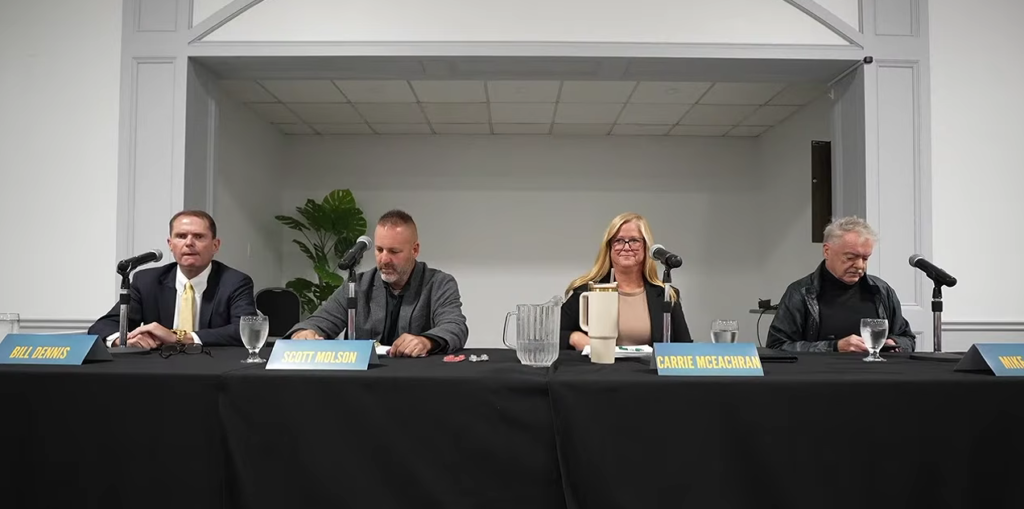
Organizers began Thursday’s Sarnia mayoral debate by warning the crowd that heckling and outbursts could result in people being escorted from the room.
By the second half of the night, moderators were quieting the audience, cutting candidates off and trying to keep increasingly personal exchanges moving.
The four remaining candidates, incumbent Mayor Mike Bradley, Coun. Bill Dennis, Carrie McEachran and Scott Molson, challenged one another over where they live, whether renters pay taxes, political connections, business finances, conduct at City Hall and who can be trusted to run it.
They also made several unusually blunt policy statements touching on strong-mayor powers, addiction and housing, immigration, DEI hiring and municipal accountability.
Just over 200 people attended the Oct. 1 Blackburn Media/Sarnia News Today debate at the Dante Club. George Stanko withdrew from the mayoral race earlier that day, leaving four candidates seeking the city’s top job.
The personal tone surfaced before the formal questions even began.
During his opening statement, Dennis invoked Bradley’s long tenure as mayor.
“We’ve all seen Mike’s movies and the sequels don’t get any better,” Dennis said.
The escalation that followed was particularly notable because the candidates were later asked directly about political civility.
The moderator noted the increasingly hostile state of political discourse and asked how each candidate would work with people who hold opposing views.
McEachran said she would “work with anyone,” regardless of political affiliation or beliefs.
Molson said: “I have proper decorum and I will lead by example.”
Dennis described himself as having been “the only conservative on a far far-left council,” said municipal politics is “very much partisan,” and concluded that he could work with anyone “as long as they’re decent people and that I respect them.”
Bradley said newly elected councillors ultimately decide how they will conduct themselves.
“If they choose to be disruptive, that’s their choice,” he said. “And the public usually makes a strong judgment on that.”
The debate soon put those answers to the test.
Some of the sharpest exchanges centred on McEachran.
She had opened the night by telling the audience she first moved to Sarnia 29 years ago, when the city’s population was around 70,000.
“When I look at the population now, almost 30 years later, it’s 70,000,” she said, contrasting Sarnia’s population growth with communities including Brantford, St. Thomas and Woodstock.
Later, during a question about McEachran’s recent appointment to the Sarnia Police Service Board, Dennis alleged the appointment had been a “formality” because her husband’s family owns a cottage next to Premier Doug Ford.
He called it a “patronage appointment.”
McEachran did not dispute the claimed family cottage connection during the exchange, but rejected Dennis’s assertion that it had anything to do with her appointment.
“That has nothing to do with my appointment,” she said.
McEachran said the position had been publicly advertised and that she was selected because of her experience, governance background and commitment to the community.
“Anyone in this room could have applied for that appointment,” she said.
Dennis responded: “Does anyone else live beside Doug Ford?”
“I don’t live beside Doug Ford,” McEachran replied. “I live in Sarnia.”
Ontario’s formal Order in Council appointed McEachran to the Sarnia Police Service Board effective March 26 and identifies her as “Carrie Lynn McEachran of Mooretown.”
Dennis then shifted from McEachran’s appointment to her residency.
He alleged she rented a place in Sarnia three or four months before declaring her candidacy and described the move as “a ploy.”
Then he went further.
“One thing’s for certain, she doesn’t pay taxes in Sarnia,” Dennis said, adding that he believed he and Molson were the only candidates at the table who “actually pay taxes in Sarnia.”
McEachran immediately broadened the exchange beyond herself.
“I pay taxes just like anybody else,” she said. “Is there anybody else in this room that rents? Because that is part of taxes, Bill, 100 per cent.”
Sarnia property-tax bills are issued to property owners, meaning residential tenants generally do not receive a municipal property-tax bill in their own name.
McEachran argued that renters nevertheless contribute toward those costs through the rent they pay.
She said she moved into Sarnia on Jan. 1, 2026 because her family situation had changed.
“I shouldn’t have to explain this over and over again, but I am,” she said.
“I did not move to Sarnia to run for mayor.”
McEachran said she made the decision to run later, after sitting in the gallery during a council meeting and deciding “we have got to fix this problem.”
Her account describes a much longer connection with the city than the current campaign: she said she first moved to Sarnia 29 years ago and that she moved back into the city Jan. 1.
Molson also challenged McEachran over her work on the police board.
He said video of a recent meeting appeared to show board members simply “nodding their heads” and accepting information without questioning it.
McEachran said she does her homework before meetings and frequently asks questions in advance, meaning some of her questions have already been answered by the time the public meeting begins.
Molson then questioned the costs associated with repairs to police headquarters, asking about procurement, quotes and why problems involving the front stairs had not been addressed after moisture was identified years earlier.
McEachran replied that she does not work for Sarnia Police and had only been on the board since April, meaning she could not answer many of the operational questions.
The candidates also gave sharply different answers about how they would use Ontario’s strong-mayor powers.
Bradley defended his selective use of the powers, pointing to the budget and his intervention in the proposed police headquarters project, and said he uses them strategically.
Dennis said he would have “no problem” using them.
He accused some City Hall employees of having “forgotten who they work for” and said residents already call him when they have trouble getting municipal service.
“I’m the one they call,” Dennis said. “I’m Spider-Man. I’m Batman. I’m the one that they call.”
Dennis said City Hall would be run like a business and promised “a new sheriff in town.”
“If they’re not on the same team, either they’re in or they’re out,” he said.
McEachran said she could only imagine overriding council in an extreme emergency and that her preference would be to work through council.
Molson likewise rejected routine use of the powers.
“I will not be a dictator,” he said, adding that if he ever did invoke them, he would publicly explain why.
The candidates’ language became equally blunt during a discussion about homelessness and addiction.
Dennis said there was “no money tree” to pay for affordable housing and vowed to oppose what he called “drug enabling housing” in residential neighbourhoods.
“I will die on the hill,” he said.
Dennis said he would “fight to the death with the county” against such projects, arguing they would hurt property values, quality of life, businesses and children’s safety.
“If you don’t like how I think, then don’t vote for me,” he said.
Dennis went on to say he had no problem helping people “down on their luck” in what he called the “horrible Trudeau-Carney economy,” citing inflation and “mass immigration.”
While saying people suffering from addiction should receive help, Dennis also said his own extended family had experienced alcoholism and that “a lot of that is brought on by themselves.”
Molson had also said he did not want people addicted to drugs placed “in the middle of our communities,” while supporting subsidized housing for people whose homelessness is driven by economic hardship and calling for a path from crisis intervention through treatment, recovery and reintegration.
McEachran proposed creating a Mayor’s Action Committee on homelessness and addiction, saying too many committees identify solutions but fail to act on them.
“We’re going to rattle some chains at all levels of government,” she said.
Another of the night’s most striking statements came when candidates were asked how Sarnia could keep young people in the community.
Dennis said some politicians appeared to be conditioning young people to expect less.
“They’re almost, it’s almost like they want to brainwash them into accepting less,” Dennis said, citing smaller homes, not driving cars and riding bicycles.
“If that’s the lifestyle they want, hey, fill your boots,” he said, before saying he wanted young people to have the opportunity to own larger homes, cars and take vacations.
Dennis then moved to employment policy.
“I am absolutely positively against DEI hiring,” he said.
He also criticized the Temporary Foreign Worker Program, claiming “white heterosexual” young people are put at an “immediate disadvantage.”
“If I’m mayor you will not see DEI hiring practices occur at City Hall,” Dennis said.
The federal government says the Temporary Foreign Worker Program is intended as a “last resort” for employers unable to find qualified Canadians or permanent residents and requires employers to take steps to recruit workers in Canada.
Ontario’s Human Rights Code protects employees and job applicants from discrimination on grounds including race and sexual orientation, while permitting qualifying special programs designed to address disadvantage and promote equal opportunity.
The debate became even more personal when Dennis was asked directly about his own temperament.
The moderator referenced his previous Code of Conduct issues, suspended pay, restrictions on attending meetings in person and heated confrontations with city staff and members of the public.
Dennis acknowledged the concern was legitimate.
He defended his past conduct at length and conceded that during one budget meeting, “yeah, I lost my cool,” saying he believed information had deliberately been withheld from him.
While recounting his version of a dispute involving an elderly photographer, Dennis said: “If someone had have done that to my dad, he’d be crapping his teeth the next morning.”
Molson then challenged Dennis directly on whether voters could trust him to remain professional.
“To represent the City of Sarnia, we have to have proper decorum and we have to have humility,” Molson said.
He asked Dennis how residents could be confident he would not “lose your cool” when someone said something he disliked.
“I guess people are just going to have to trust me,” Dennis responded.
He then turned the discussion toward Molson’s business record.
Dennis alleged an employee had taken approximately $175,000 from Molson’s business and questioned how Molson, who has emphasized his business and financial experience during the campaign, could have failed to discover it sooner.
“I can tell you if a dime is missing from my account,” Dennis said.
Dennis then alleged, without presenting evidence during the debate, that Molson had failed to detect the problem because “you were doing cash deals.”
The moderator cut Dennis off.
Molson responded that he had been defrauded and said financial difficulties led him to bring in an accountant and an auditor, who identified missing money.
Molson said the matter was taken to Sarnia police and resulted in a criminal charge that was later dismissed. He said he subsequently sued the person in Small Claims Court and that the matter was settled.
Those statements were Molson’s account at the debate. The $175,000 figure and Dennis’s “cash deals” allegation were not independently established during the exchange.
Before the discussion moved on, McEachran directed another question at Dennis.
“How will you be able to run the city if you can’t be in person at council?” she asked.
Dennis called the restrictions imposed on him “illegal” and said that if he had sued the city, he would have won “in a New York minute.”
He contrasted his situation with accused criminals being able to enter City Hall while he could not.
“I’ll be into City Hall the day after I win the election to hold my press conference,” Dennis said. “Believe me.”
The restrictions followed a neutral third-party investigation commissioned by the City, which concluded on a balance of probabilities that Dennis had breached workplace harassment and discrimination provisions in his conduct toward City staff. Council subsequently barred him from City Hall except in limited circumstances and from attending council meetings in person, while allowing him to participate virtually.
The final major confrontation began after Molson challenged Bradley on infrastructure and city reserves.
Molson asked why, after Bradley’s long tenure, Sarnia’s infrastructure was “in such despair” and claimed reserves were “at zero.”
Bradley immediately disputed the reserve claim and argued previous councils had drawn heavily from reserves to support police spending.
Dennis then joined in.
“The little old lady on Brock Street is afraid to leave her home,” Dennis said, adapting a longstanding local political reference Bradley had just used about taxpayers’ ability to pay.
Dennis said her grandson was now living in her basement because he could not find a job.
Then he turned directly to Bradley.
“Mike, seriously, honestly, I’d be embarrassed to be running if I were you,” Dennis said.
He blamed Bradley for Sarnia losing out on the casino eventually located in Point Edward and accused him of hostility toward private enterprise.
“You’re a jealous individual,” Dennis said. “You don’t want to see people do well.”
He alleged Bradley had stood in the way of opportunities involving Toyota, Magna and Caterpillar.
When Bradley reacted, Dennis continued.
“Don’t give me that look. You know it’s true.”
Dennis began comparing Bradley to the Pied Piper before the moderator returned the floor to the mayor.
“I am simply not going to respond to that diatribe,” Bradley said.
The moderator closed the question period moments later by thanking the audience for remaining quiet “with a couple of minor exceptions.”
Amid the attacks, the debate also left voters with a growing list of promises.
Dennis pledged aggressive business recruitment, competitive procurement, stronger contractor accountability and what he repeatedly called “five-star service” at City Hall.
He promised to use strong-mayor powers when he considered it necessary, oppose DEI hiring practices at City Hall, resist housing projects he described as “drug enabling,” and focus on growing Sarnia’s tax base through jobs and investment.
In his closing statement, he acknowledged his confrontational reputation.
“I have not always been the quietest voice in the room,” Dennis said. “I have made mistakes and I will own them.”
McEachran said an early priority would be changing the culture of council and City Hall and creating a more respectful working environment.
She promised the Mayor’s Action Committee on homelessness and addiction and said she would use relationships developed through her work locally and with other governments to advocate for investment and jobs.
Calling herself a “chain rattler,” McEachran said she was willing to go to Queen’s Park and bang on the door to demand what Sarnia needs.
Molson promised public financial and infrastructure dashboards.
He said residents would be able to see where “every penny” comes into the city and where it goes, while a colour-coded infrastructure map would identify emergency work, upcoming projects and completed work.
He also promised to aggressively recruit business.
“I am prepared to be the best damn salesman you’ve ever seen,” Molson said.
Bradley said he would continue advocating for Line 5, the proposed Northern Shield pipeline, affordable housing and addiction services.
Then, in his closing statement, he added two specific accountability commitments.
Bradley promised “more accountability of Bluewater Power” and “more accountability with the police board to the City of Sarnia.”
He did not explain during the debate what additional Bluewater Power accountability would entail.
Bradley also used his closing statement to contrast himself with promises he suggested may not be achievable.
“I’m not a dream merchant,” he said. “I’m not going to promise you a bridge where there’s no river.”
The four candidates are scheduled to meet again at a sold-out Imperial Theatre mayoral debate on Oct. 19.
Sarnia’s internet voting period begins Oct. 16, with election day and in-person paper-ballot voting on Oct. 26.


Fri, Nov 20 · 8:00 am
Four Points by Sheraton 1498 Venetian Blvd Point Edward, ON
Fri, Nov 20 · 10:00 am
Corunna Legion 350 Albert/Beckwith Streets Corunna, ON