


Nov23
Ontario restricts housing around Cargill after years of local planning
Farmers sought protection for a vital grain terminal. Neighbouring housing plans had already faced council votes, technical studies and a provincial tribunal.
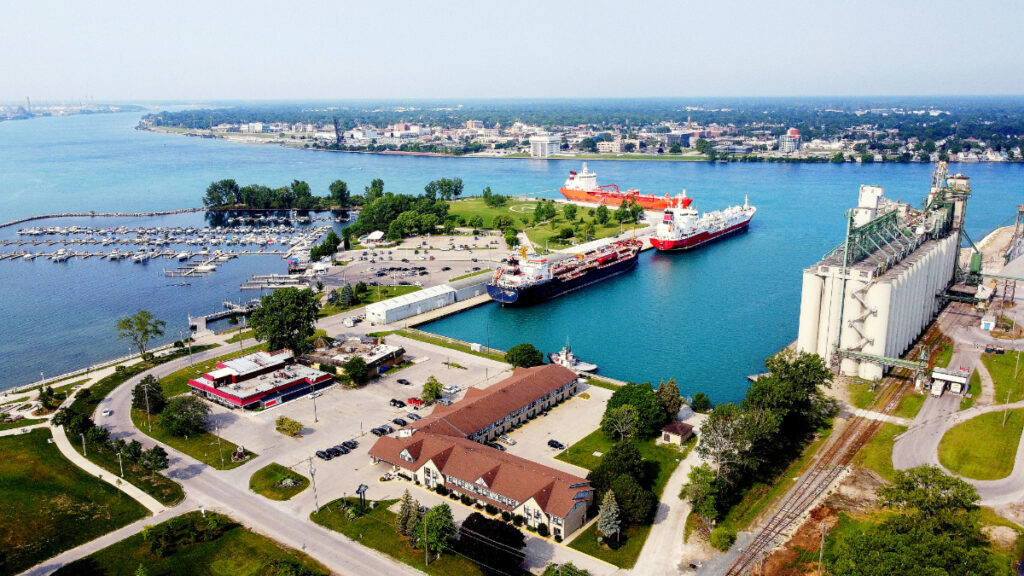
Ontario has decided that protecting Cargill’s grain terminal means restricting what can be built around it, putting waterfront housing plans in Sarnia and Point Edward in jeopardy after years of local approvals, studies and negotiations.
Two minister’s zoning orders signed November 20 restrict sensitive land uses within 300 metres of the terminal at 101 Exmouth St. One applies to Sarnia, the other to Point Edward.
For farmers who depend on the terminal to get their crops to market, the decision offers protection against a familiar problem: homes move closer to an industrial operation, residents complain, and the business faces pressure to change how it works.
For the municipalities and neighbouring landowners, it raises a different problem. They had already been working through those conflicts using the planning system Ontario gave them. In Point Edward, that included a settlement approved by the province’s own land tribunal.
The dispute has always involved more than whether a grain terminal belongs on the waterfront. It also involves how much protection that operation requires, what that costs the people around it, and who gets to make those decisions.
A working harbour, and land people want to live on
The terminal was built in 1927, according to Cargill. The company purchased it in 1988, as the Journal previously reported. Grain handling has been part of this waterfront for almost a century, alongside a changing mix of shipping, restaurants, parkland and residential development.
The Ontario Federation of Agriculture’s submission puts the terminal’s importance in practical terms. It handles approximately 35 per cent of Ontario’s grain export capacity and receives fertilizer used across nearly 400,000 acres of farmland. About 30 ships and 20,000 trucks visit each year, with rail connecting the operation to the wider transportation network.
That is why farm organizations see something larger than a disagreement between a company and a developer. Restrictions on grain handling in Sarnia could be felt by farmers well beyond Lambton County.
Their concern is about what happens over time. Noise, dust, odour, lights and heavy traffic are ordinary parts of this operation. They can also make living nearby unpleasant. Putting homes beside the terminal creates the possibility of complaints, regulatory pressure and limits on its hours or expansion.
The OFA backed the zoning order, while also asking Ontario to update its planning guidelines so communities could avoid similar conflicts without needing a minister to intervene.
Cargill’s objection to the Harbour Road proposal explains why it was not satisfied with assurances about better construction. Its consultants argued that a 14-storey building would put residents above the protection offered by ordinary noise barriers, overlooking the terminal’s operations. Future equipment changes could then require more difficult and expensive noise controls.
The consultants also questioned whether traffic studies properly captured the busy season. Their review described roughly 200 trucks a day from July through December, compared with about 20 daily during the quieter first half of the year.
Those concerns help explain the company’s position. The disagreement was whether they could be addressed through conditions on individual developments, or required a provincial restriction across surrounding land.
Point Edward had already been through the tribunal
The housing proposal north of Exmouth Street did not appear after Cargill asked for protection.
In June 2023, Point Edward council approved a zoning amendment for a proposed 156-townhouse development on approximately 23 acres across from the elevators. The Journal’s reporting at the time recorded warnings from farmers and industrial representatives about dust, noise and the difficulty of keeping residential expectations compatible with a working harbour. Residents and other speakers also raised habitat and affordability concerns.
Sarnia appealed the approval. Its concerns included industrial compatibility and the Exmouth Street oversize-load corridor, which allows large industrial equipment to reach the docks. By April 2024, much of the site had been cleared, but negotiations and servicing questions remained.
The municipalities and developer eventually reached a settlement through tribunal-led mediation. The February 26, 2025 tribunal decision traces the changing plans: an initial 156 units, a revised 184-townhouse submission, then a framework for phased development.
The settlement, signed in December 2024 by Sarnia, Point Edward and 2858946 Ontario Inc., allowed a first phase of up to 350 homes once conditions were met. Further development required additional conditions.
Those conditions dealt with water and sewage capacity, servicing costs, a second road access and noise mitigation. Development beyond 350 units required further traffic work. Detailed site-plan or condominium approvals were still needed.
The tribunal accepted the planning evidence and found the settlement represented good planning and served the public interest.
That history matters. The municipalities had not ignored the terminal and waved the housing through. Sarnia had challenged the proposal, the parties had negotiated safeguards, and a provincial tribunal had accepted the result. The new orders place another restriction over that work.
The same harbour, different decisions
Cargill asked the province for its zoning orders on December 17, 2025. On January 19, Sarnia council formally objected, saying the request undermined the city’s ability to make local planning decisions. Chrissy McRoberts moved the objection and Terry Burrell seconded it. The motion carried.
Four months later, the city considered Tricar Properties’ proposal for the former Stokes By the Bay site at 485 Harbour Rd.: 105 homes in a 14-storey building with commercial space at ground level.
The May 25 minutes show council approved the planning amendments 7–2. Dave Boushy, Bill Dennis, Adam Kilner, McRoberts, George Vandenberg, Brian White and Mayor Mike Bradley supported them. Burrell and Anne Marie Gillis opposed them, after an earlier motion to deny the application failed by the same split.
The minutes also record former Stokes owner Michele Stokley and Paddy Flaherty’s owner Scott Dargie supporting the application. Both said they had not experienced negative impacts from the nearby industrial uses.
The city’s planning recommendation was conditional. Residential development would remain on hold until further risk, dust and compatibility work was completed. Staff also recommended a Class 4 noise designation, intended to accommodate housing near existing industry, and construction measures to reduce noise exposure.
County planners disagreed. They questioned whether the proposed sensitive use belonged so close to significant industrial and transportation facilities and whether the technical work showed the impacts could be addressed. City planners acknowledged the concerns but believed a conditional approval could protect employment uses while allowing the waterfront to change.
On September 2, county council sided against the development. The recorded vote defeated Bradley and Dennis’s motion to approve the official-plan amendment by 22–15 under the county’s weighted voting system.
Six members supported approval: Boushy, Bradley, Dennis, Bev Hand, Brad Loosley and McRoberts. Jeff Agar, Gary Atkinson, Al Broad, John Couwenberg, Doug Cook, David Ferguson, Kevin Marriott, Steve Miller, Dan Sageman, Ian Veen and White voted against it.
Council then carried a motion refusing the amendment because it was not consistent with the Provincial Planning Statement and did not conform to the county’s official plan. It also declined to endorse the proposed Class 4 noise designation.
Even within local government, then, there was no single position for Ontario to uphold. The city and county had reached different conclusions about the same development. White supported it at city council and opposed it at county council.
What the province has settled, and what it has not
Ontario’s decision backs Cargill’s request for protection. The ministry says the orders are intended to prevent incompatible uses and support the terminal’s continued operation and economic viability.
The consultation drew 615 submissions, most supportive. Opposition came from municipal representatives, landowners, development interests and members of the public. County staff also raised technical concerns.
The original request included study requirements for development between 301 and 650 metres from the terminal. The final decision notice describes restrictions within 300 metres. The wider proposal should not be treated as the final boundary.
For Point Edward, the decision also raises questions about the reliability of an approval reached through years of negotiation. Mayor Greg Grimes told The Independent that he believed residential development on the affected village property could no longer proceed, though other kinds of development might still be possible.
“I’m concerned that the developer operated in good faith and met all the conditions,” he said.
The village’s experience leaves a practical question for anyone considering a project nearby: how much can they rely on the local process if a provincial order can subsequently change what the land may be used for?
There are questions on the other side of that decision, too. Farmers need dependable access to markets, and the terminal needs room to operate. Neighbouring owners and future residents also have an interest in how much land is set aside from housing and whether particular conflicts can be managed.
The province has now given the terminal additional protection. What becomes of the housing proposals, and what the affected land can become instead, is the next decision facing Sarnia and Point Edward.
More to read

 New Sarnia council faces projected $2.3-million year-end deficit
- Sarnia councillors propose deputy mayor, financial reviews and searchable voting records

Events
Nov23
Scottish Country Dancing
Mon, Nov 23 · 7:00 pm
St Andrew’s Presbyterian Church 261 Christina St N Sarnia, ON
Nov23
Monday Night Trivia @ Black Gold
Mon, Nov 23 · 7:00 pm
Black Gold Brewery 395 Fletcher St Petrolia, ON
Nov24
Nov24
SARNIA’S BEST TRIVIA at Refined Fool
Tue, Nov 24 · 5:00 pm
Refined Fool Brewing Co. Refined Fool Brewing Co Kids with Fur, 1308 London Rd, ON N7S Sarnia, ON