


Nov23
Aamjiwnaang calls for immediate engagement on proposed Northern Shield pipeline
Sarnia-Lambton politicians hailed the proposed Northern Shield Energy Corridor pipeline from Alberta to local refineries as a boost for jobs and energy security. Aamjiwnaang First Nation says no consultation has taken place, calling for engagement amid existing environmental challenges. The project remains in feasibility stages.
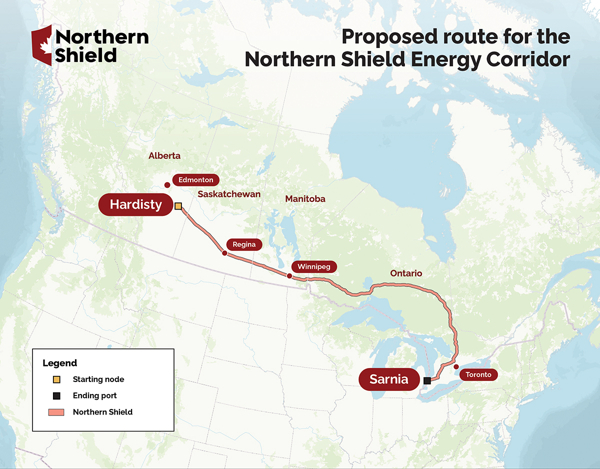
Aamjiwnaang First Nation is calling for immediate Crown engagement on the proposed Northern Shield pipeline, warning the project would run through and terminate in the heart of its territory while the community is already dealing with serious cumulative industrial impacts.
The July 7 statement from Chief Janelle Nahmabin followed the July 6 announcement by Ontario Premier Doug Ford and Alberta Premier Danielle Smith of the proposed Northern Shield Energy Corridor, a 3,300-kilometre crude oil pipeline from Hardisty, Alta., to Sarnia.
The Ontario government says it has “initiated its duty to consult with Indigenous partners and communities” as part of the proposal.
Nahmabin told The Sarnia Journal she had anticipated some form of east-west pipeline proposal could eventually emerge following earlier public discussions between Ontario and Alberta on energy infrastructure. But she said Aamjiwnaang should have been included before any proposed route was publicly announced.
The proposal has been welcomed by Sarnia-Lambton politicians and business organizations as a source of potential jobs, investment and energy security. But Aamjiwnaang says any decision about new infrastructure in its territory must include the First Nation from the beginning, not after key decisions have already been made.
“Aamjiwnaang exercises Aboriginal, Treaty, and Title rights, as well as inherent Indigenous rights,” the statement says. “These rights carry with them our sacred responsibilities to care for the land, water, and resources within our territory.”
The First Nation said it understands from media reports that the proposed pipeline would “run through and terminate in Sarnia, Ontario, in the heart of our territory.”
“Our territory is home to significant industrial activity, and our community continues to experience serious cumulative environmental impacts that must be central to any conversation about future projects,” the statement says.
Aamjiwnaang pointed to an ongoing benzene crisis since 2024, routine spikes high enough to affect the community’s ability to safely spend time outdoors, worsening sulphur dioxide concentrations during the second quarter of 2026, and a March 2026 pipeline spill adjacent to its territory that entered the St. Clair River.
“Our community is already living in a state of environmental emergency; adding new pipeline risks without addressing existing harms is unacceptable,” the statement says.
The statement calls on the Crown to begin engagement with Aamjiwnaang during the earliest stages of planning, before any approvals or commitments are made. It says meaningful engagement must include recognition of the First Nation’s jurisdiction and decision-making authority, along with a shared commitment to understanding the environmental conditions in which any new project would operate.
Nahmabin said consultation should have begun before the proposed route was announced because the corridor would cross numerous First Nation territories. She said planning projects of national significance across Indigenous territories without involving affected First Nations from the outset continues a long-standing pattern of governments making decisions before Indigenous communities are brought into the process.
She said early engagement would provide greater certainty for projects of national interest by allowing governments and First Nations to work together from the beginning rather than leaving communities to respond after announcements have already been made.
“If you want to have security with [a] big project, it is important that you engage First Nation and include them along the way,” Nahmabin said.
She said meaningful consultation at the earliest stages could help prevent delays by ensuring First Nations are working toward the same goals instead of being forced to “play catch up” once plans become public.
Nahmabin also said governments should not repeat past decisions that prioritized industrial development before addressing the environmental burdens already affecting communities like Aamjiwnaang.
“We have documents that show that our rights have continuously been trampled on here within the region for the sake of industry,” she said. “Canada would do well not to repeat those mistakes.”
Grand Chief Joel Abram of the Association of Iroquois and Allied Indians echoed those concerns, saying major infrastructure projects require free, prior and informed consent, environmental protection and equitable benefit-sharing from the outset.
“Free, prior, informed consent has to mean something real,” Abram said, according to APTN News.
The proposed Northern Shield corridor remains in its early stages. Ontario and Alberta say the pipeline would initially carry up to 500,000 barrels of oil per day, with the potential to expand to 800,000 barrels per day. A feasibility study is expected later this year.
Local political reaction has been strongly supportive. Sarnia-Lambton MPP Bob Bailey described the proposal as a nation-building project, while St. Clair Township Mayor Jeff Agar pointed to opportunities for refinery-related employment. Sarnia Mayor Mike Bradley called the announcement “a banner day,” and Sarnia—Lambton—Bkejwanong MP Marilyn Gladu said the project would strengthen jobs, refinery certainty and Canadian energy sovereignty.
Business groups, including the Sarnia-Lambton Economic Partnership and the Sarnia-Lambton Chamber of Commerce, have also highlighted opportunities for local industry and supply chains.
But Aamjiwnaang says the proposed endpoint cannot be viewed only through an economic lens.
“Responsible planning requires that existing conditions, cumulative effects, and ongoing health concerns be fully understood and addressed before any decisions are made,” the statement says.
More to read

 Sarnia councillors propose deputy mayor, financial reviews and searchable voting records
- New Sarnia council faces projected $2.3-million year-end deficit

Events
Nov23
Scottish Country Dancing
Mon, Nov 23 · 7:00 pm
St Andrew’s Presbyterian Church 261 Christina St N Sarnia, ON
Nov23
Monday Night Trivia @ Black Gold
Mon, Nov 23 · 7:00 pm
Black Gold Brewery 395 Fletcher St Petrolia, ON
Nov24
Nov24
SARNIA’S BEST TRIVIA at Refined Fool
Tue, Nov 24 · 5:00 pm
Refined Fool Brewing Co. Refined Fool Brewing Co Kids with Fur, 1308 London Rd, ON N7S Sarnia, ON