Nov13
Opinion
This column reflects the views of its author.
Learning the language of justice
In Nathan’s latest column, a $1.5-million lawsuit leads to a bigger question: why does accessing justice require learning an entirely different language?
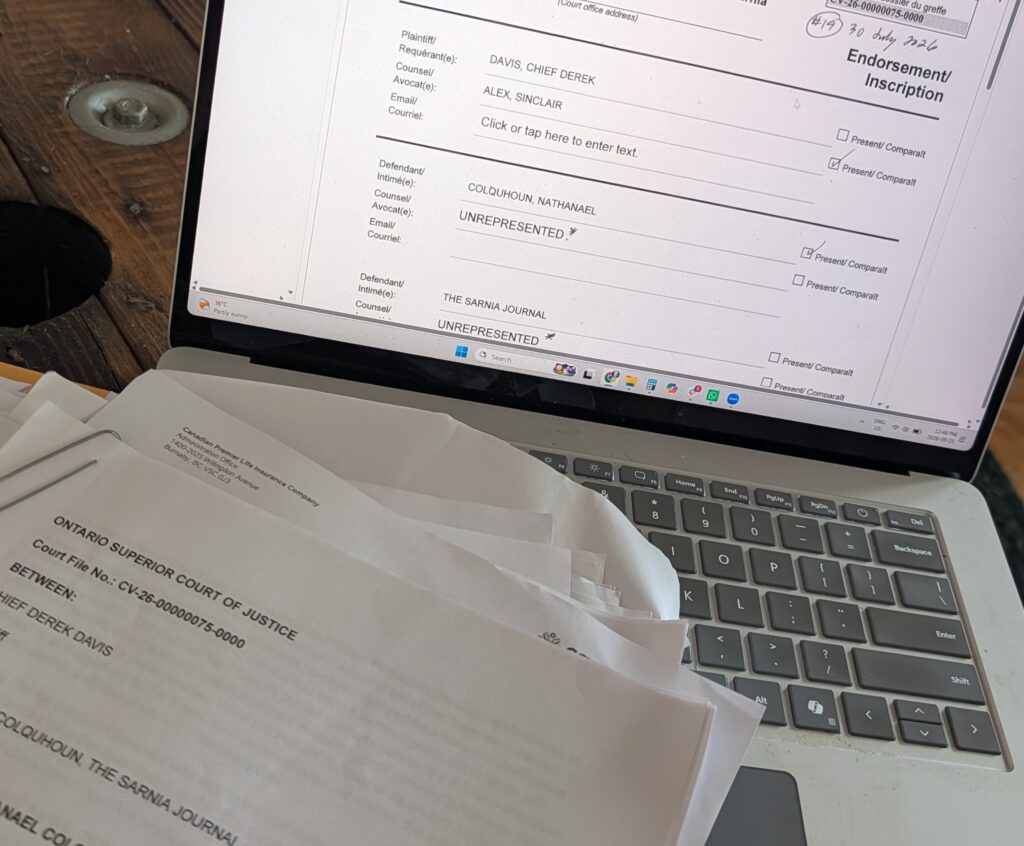
I'm sitting in court right now on Zoom listening to lawyers argue with each other.
Not my court case yet. I'm waiting for mine.
For context, the Chief of Police sued me and The Sarnia Journal for $1.5 million earlier this year. He eventually discontinued the lawsuit, and now I'm here representing myself and the Journal, trying to recover some of the costs we incurred defending it.
I've spent hundreds of hours learning enough about the legal system to be able to do this. Motions. Affidavits. Rules of Civil Procedure. Case law. Costs submissions. All the little procedures and words that you apparently need to know before you're allowed to explain to a judge what happened to you.
And sitting here listening to everyone else's cases, I can't get over how strange this whole thing is.
There are people whose lives are actually being affected by whatever happens in this room. Money, homes, businesses, reputations, relationships. Real things. And for the most part they aren't talking.
Their lawyers are.
The lawyers talk to the judge. The lawyers talk to each other. They cite other judges talking about what other lawyers once argued. Everyone has learned the language and the procedures and knows when they're allowed to speak and what they're allowed to say.
And somewhere underneath all of it are just people trying to resolve something that happened between them.
I know this isn't some groundbreaking observation. Lawyers exist because law is complicated. There are rules of evidence and procedure for good reasons. Expertise matters. I'm not suggesting we throw everyone into a room and let whoever yells loudest win.
But c'mon.
Surely we've made this more complicated than it needs to be.
I've had this feeling over and over again while representing myself. The hardest part hasn't necessarily been understanding the ideas. It's figuring out how the system wants me to say them.
There is something backwards about that.
If justice is something that ordinary people are supposed to have access to, why does accessing it require becoming temporarily proficient in an entirely different language? Or paying someone who already speaks it to stand between you and the person making the decision?
I'm probably noticing this more because I don't have a lawyer.
There is no buffer between me and the machinery.
When a rule doesn't make sense, I have to figure it out. When a form is confusing, I have to figure it out. When someone references a case or a procedure I've never heard of, I have to go learn what it means.
And strangely, the more I've learned, the less mystical much of it seems.
There are obviously complicated legal questions that require serious expertise. But there are also an incredible number of human questions buried under layers of professional procedure.
Someone sued someone.
Someone spent money defending themselves.
Someone abandoned the lawsuit.
Now someone has to decide who should reasonably bear those costs.
That's basically why I'm here today.
Yet to get to that very human question, we've constructed an entire professional ecosystem that most people could never navigate without paying someone thousands or tens of thousands of dollars.
And that has to affect what justice actually means.
Because a right you can only meaningfully exercise if you can afford an expert to translate you into the language of the institution isn't really the same right for everyone.
Maybe that's what is bothering me sitting here.
It's not that lawyers are doing anything wrong. They're doing exactly what we've built the system for them to do.
It's that we've built a justice system where the people most affected by the decisions can somehow become the least important voices in the room.
I'm sitting here listening to extremely intelligent people make careful arguments on behalf of other people and wondering whether somewhere along the way we confused legal sophistication with justice.
Maybe sometimes they're the same thing.
But surely not always.
Anyway, my case should be coming up soon.
I guess I'll find out how well I've learned the language.
More to read
 Sarnia council’s inaugural meeting set for Nov. 16

 Lambton College open house to offer look at new residence plans
 cineSARNIA presents Once Upon a Time in a Cinema on Nov. 22
Events
Nov13
Nov14
Nov14
Nov14
Dinosaur Bone Cleaning Demonstrations with PaleoJoe
Sat, Nov 14 · 10:00 am
Port Huron Museums Carnegie Museum